Introduction
St James’s Church, West Littleton's noteworthy collection of nine listed chest tombs on the south east approach to the entrance porch have undergone a major programme of conservation work between July and September 2010. This page records the appearance of the tombs before and after conservation. A full report of the work done can be viewed in the Nimbus report here.
Tomb No.1
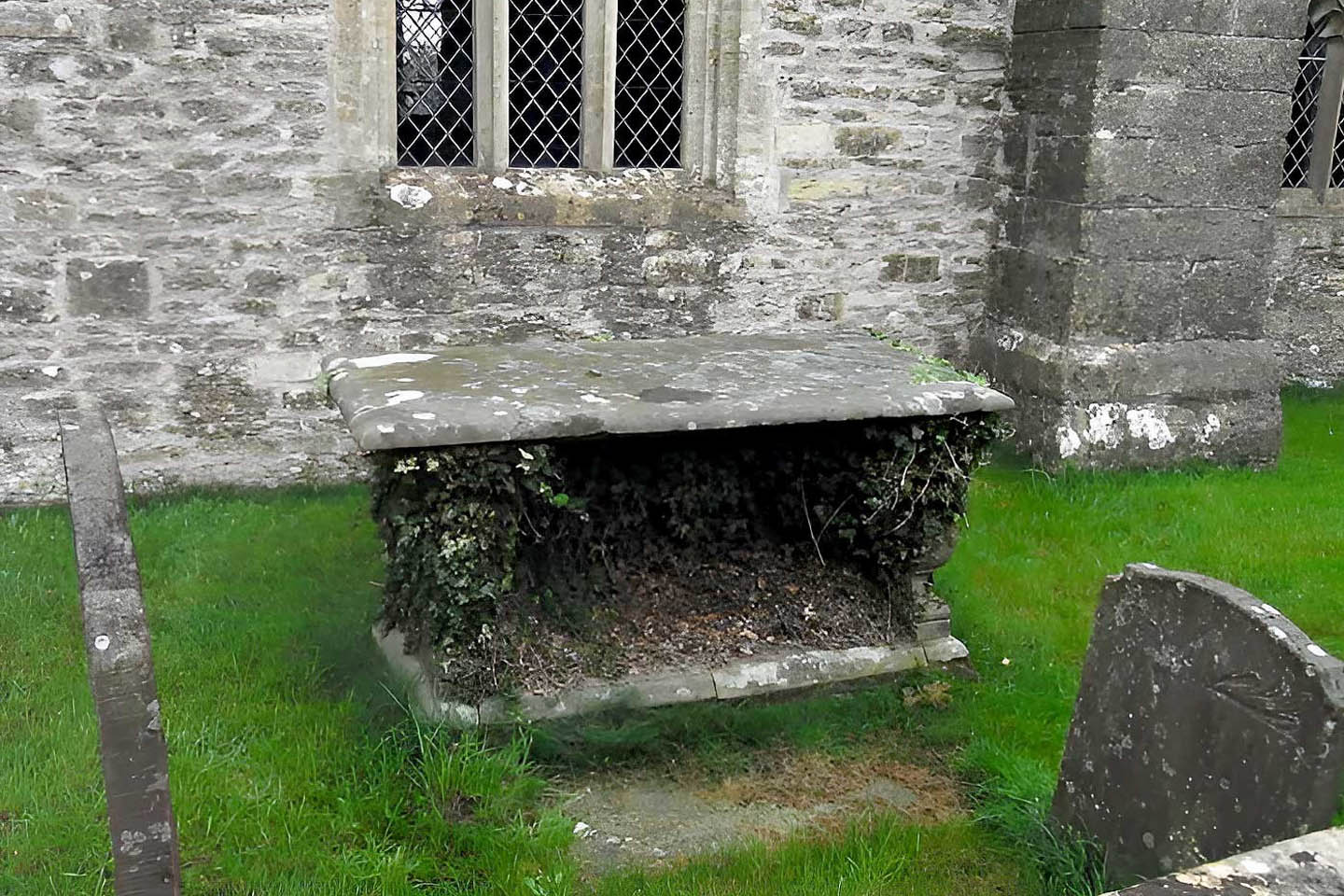
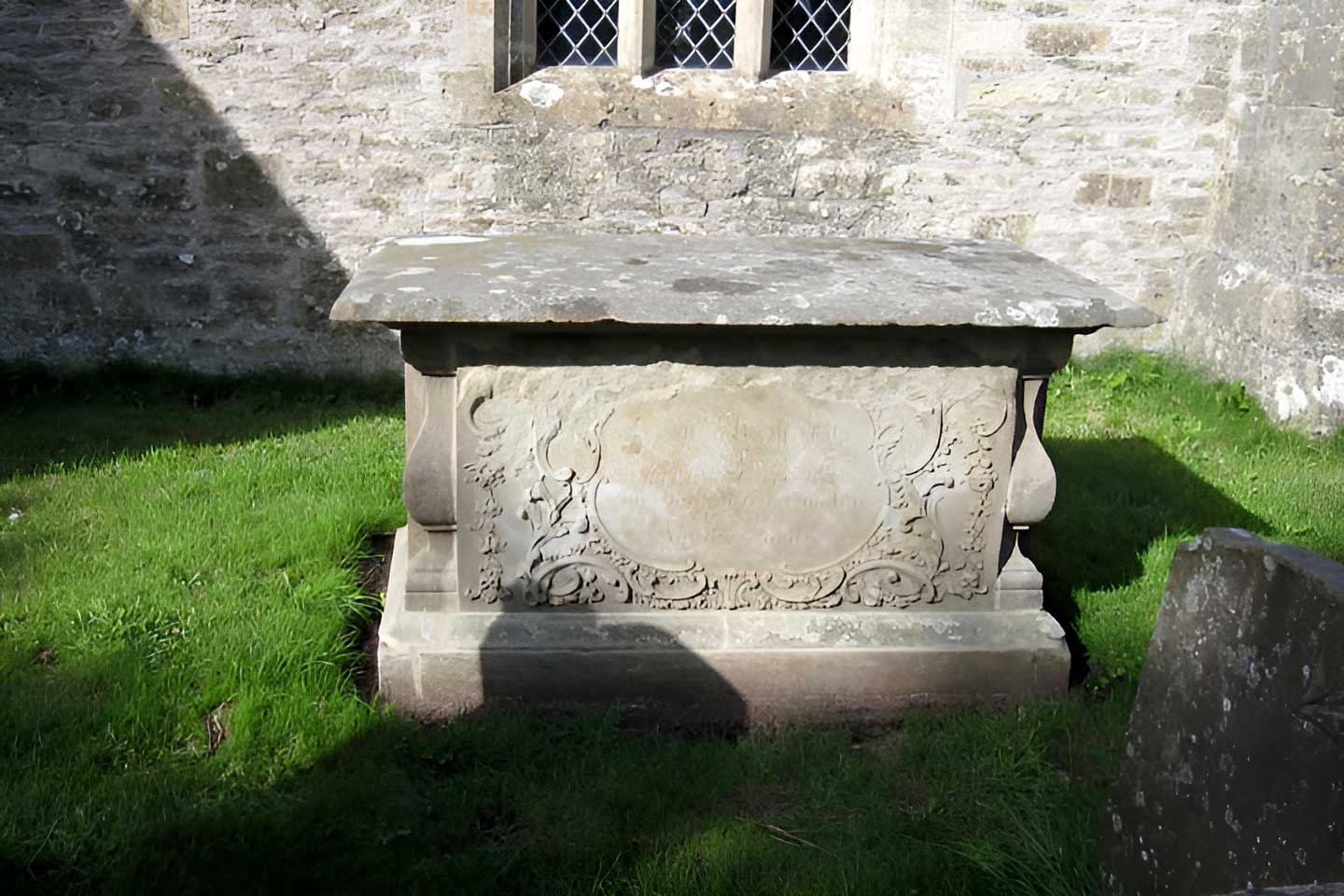
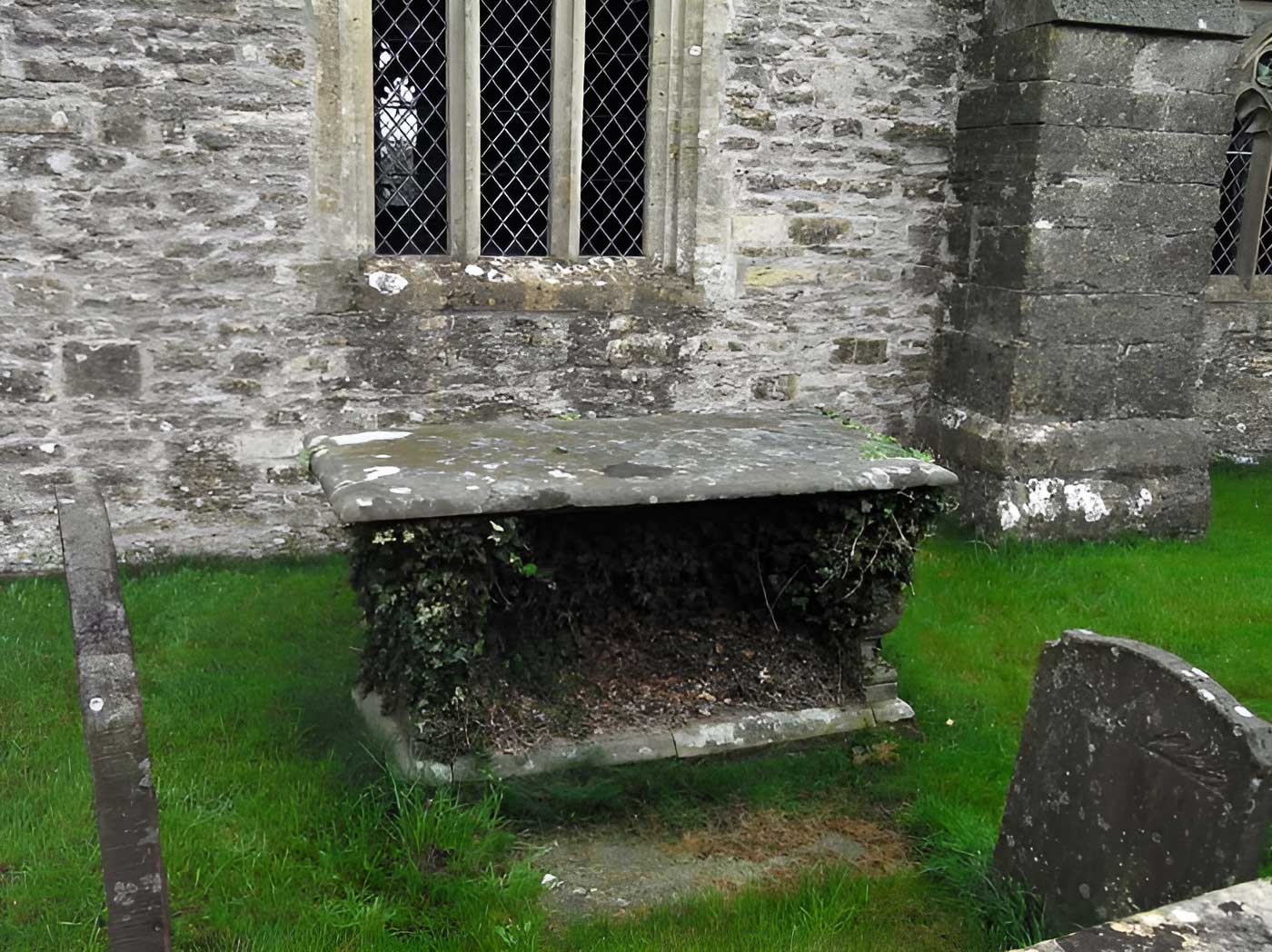
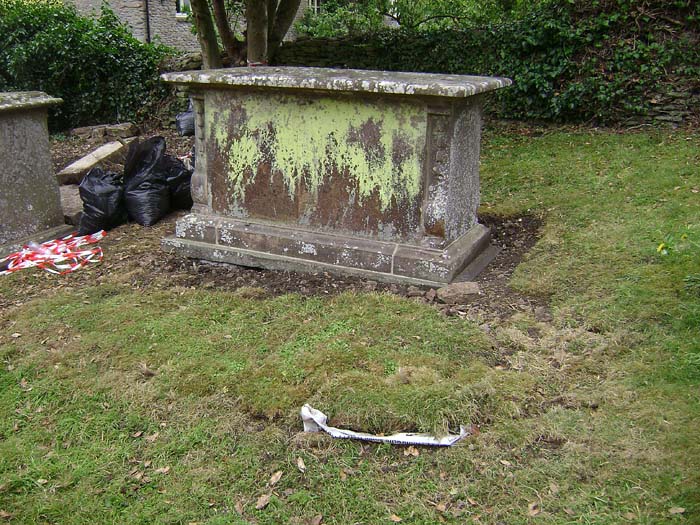
An 18th Century table top tomb in fine grained green sandstone with a plain flat lid and plain ends with half baluster corners. The monument was completely overgrown with ivy, inside and out. One of the side panels had fallen many years ago and was lying beside the tomb. The ferrous fixings were rusted and were causing instability. The side panels were showing areas of delamination.
Before
After
Conservation work
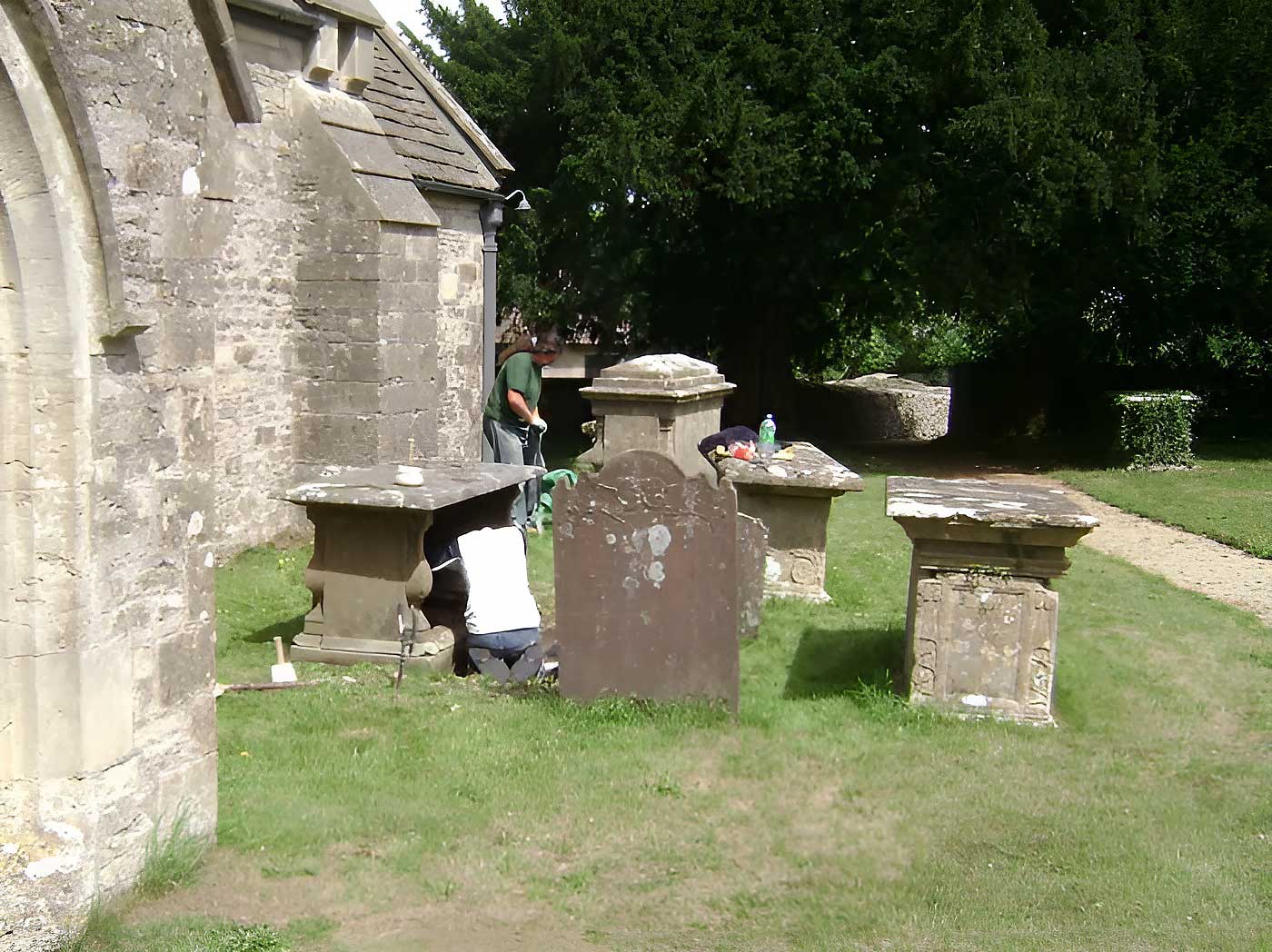
Firstly, the vegetation was carefully cut away from the monument. The south side panel was then lifted from the ground and found to be in remarkably good condition with the carved cartouche and inscription still legible. The lid of the tomb was removed. The fallen panel was brush cleaned of soil and rinsed with clean water to try and remove as many of the soluble salts blooming on the surface as possible. This washing process was carried out 5 times. The monument sides were realigned and fixed into position with new stainless steel cramps set in resin. The laminations in the sandstone were repaired by grouting with a hydraulic lime and stone dust mix injected into fissures. Lime mortar repairs were applied to upper surfaces of the laminations to reduce water ingress causing further damage.
The lid of the tomb was then lifted back into position and the whole monument was repointed using a hydraulic lime mortar mix. The turf around the base was cut back and a geo-textile liner was placed around all four sides and covered with top soil to reduce future weed growth.
Tomb 1 initial condition
Before work starts.
Tomb 1 - work in progress
Working on the collapsed side panel and cleaning the interior.
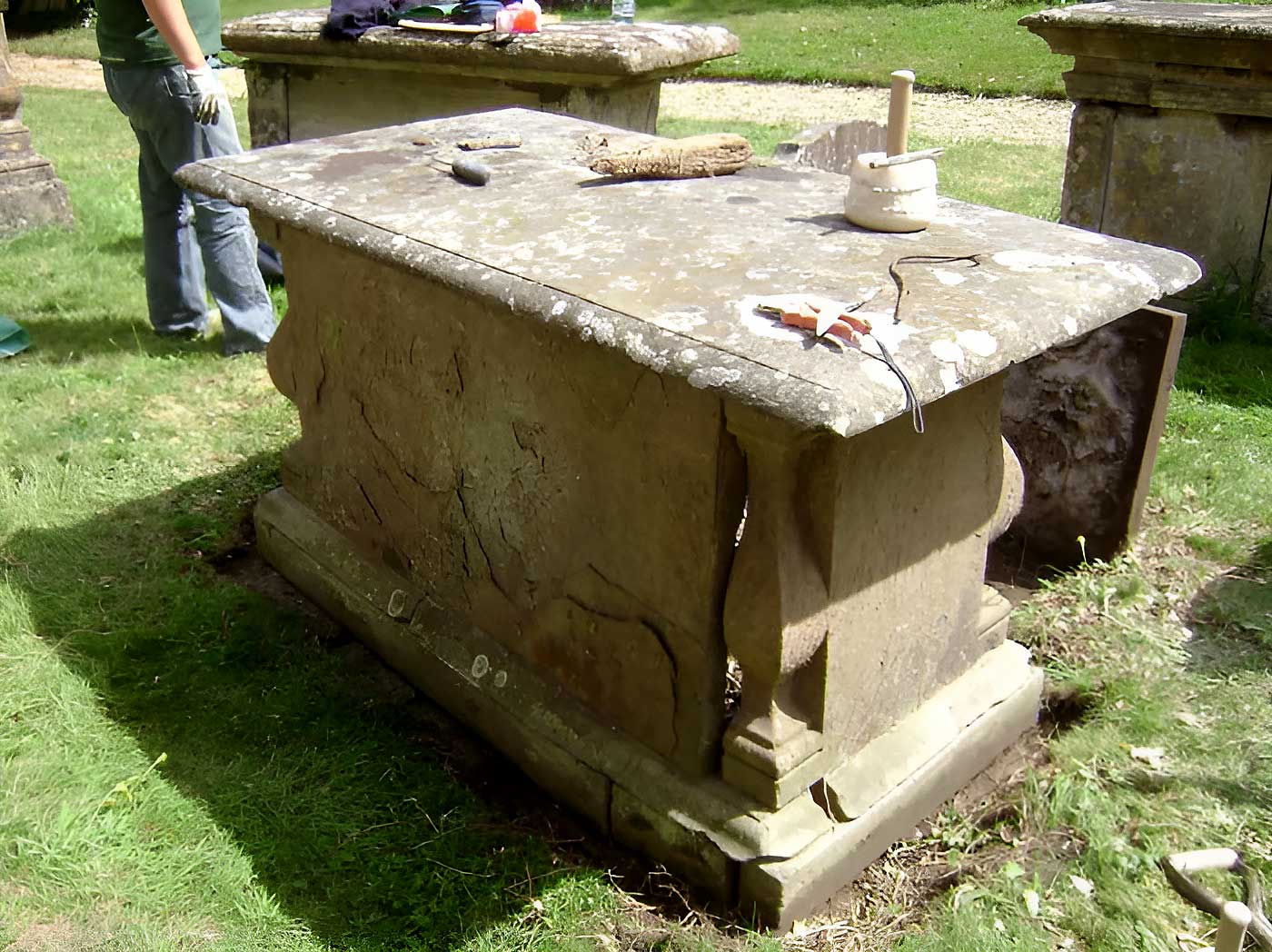
Tomb 1 - work in progress
After removing the ivy.
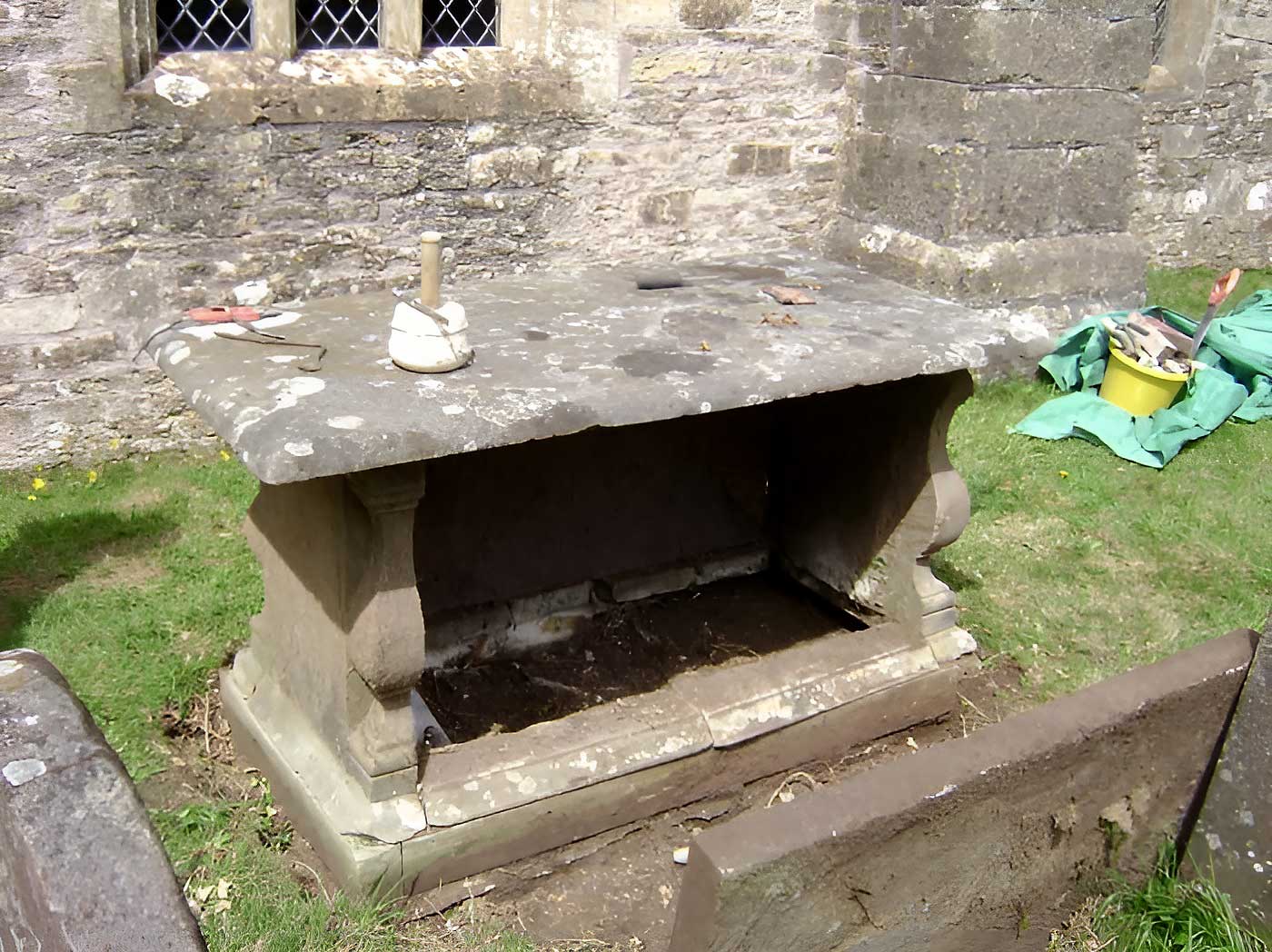
Tomb 1 - work in progress
After cleaning inside.
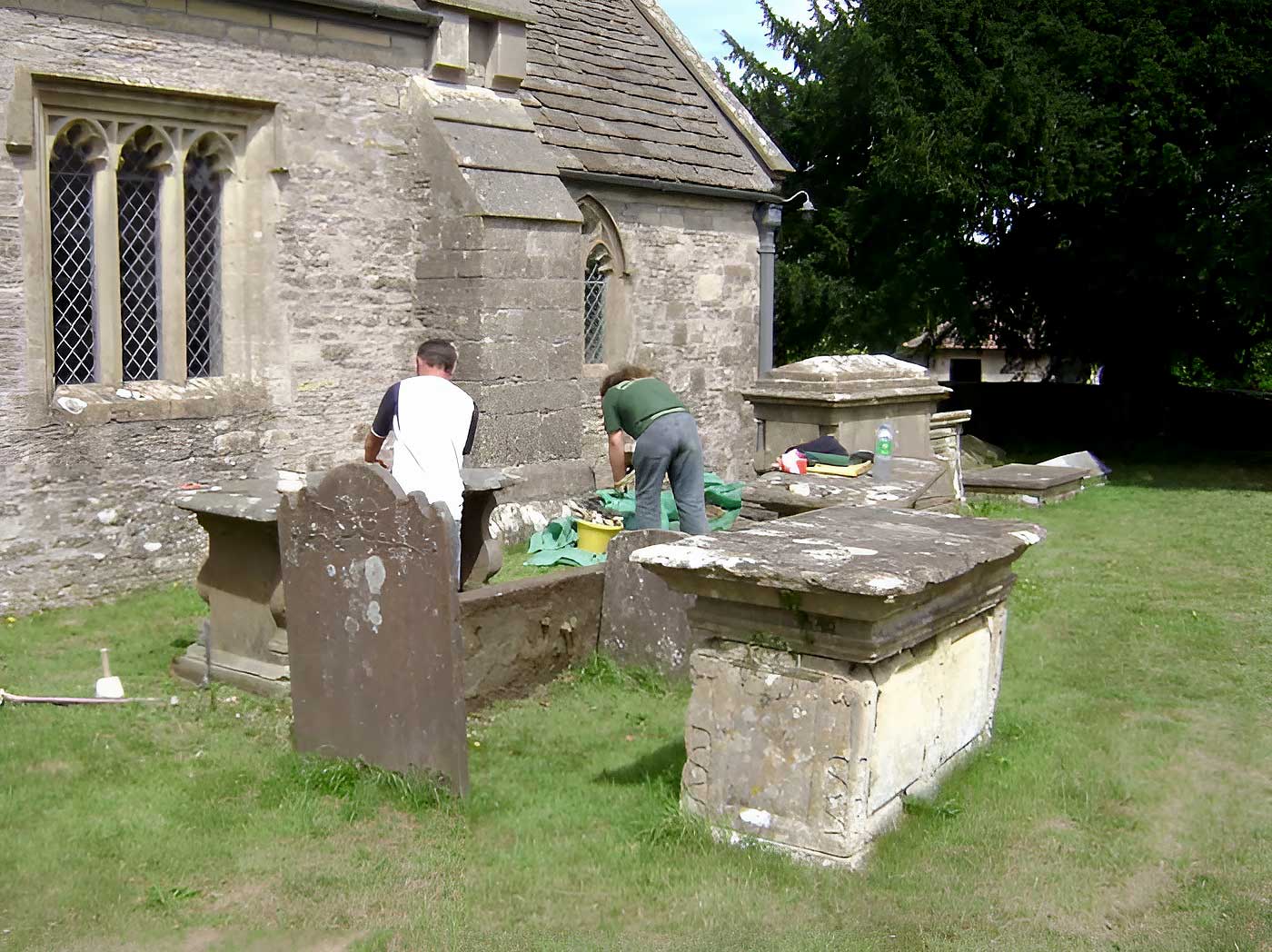
Tomb 1 - work in progress
Missing side lifted from the ground.
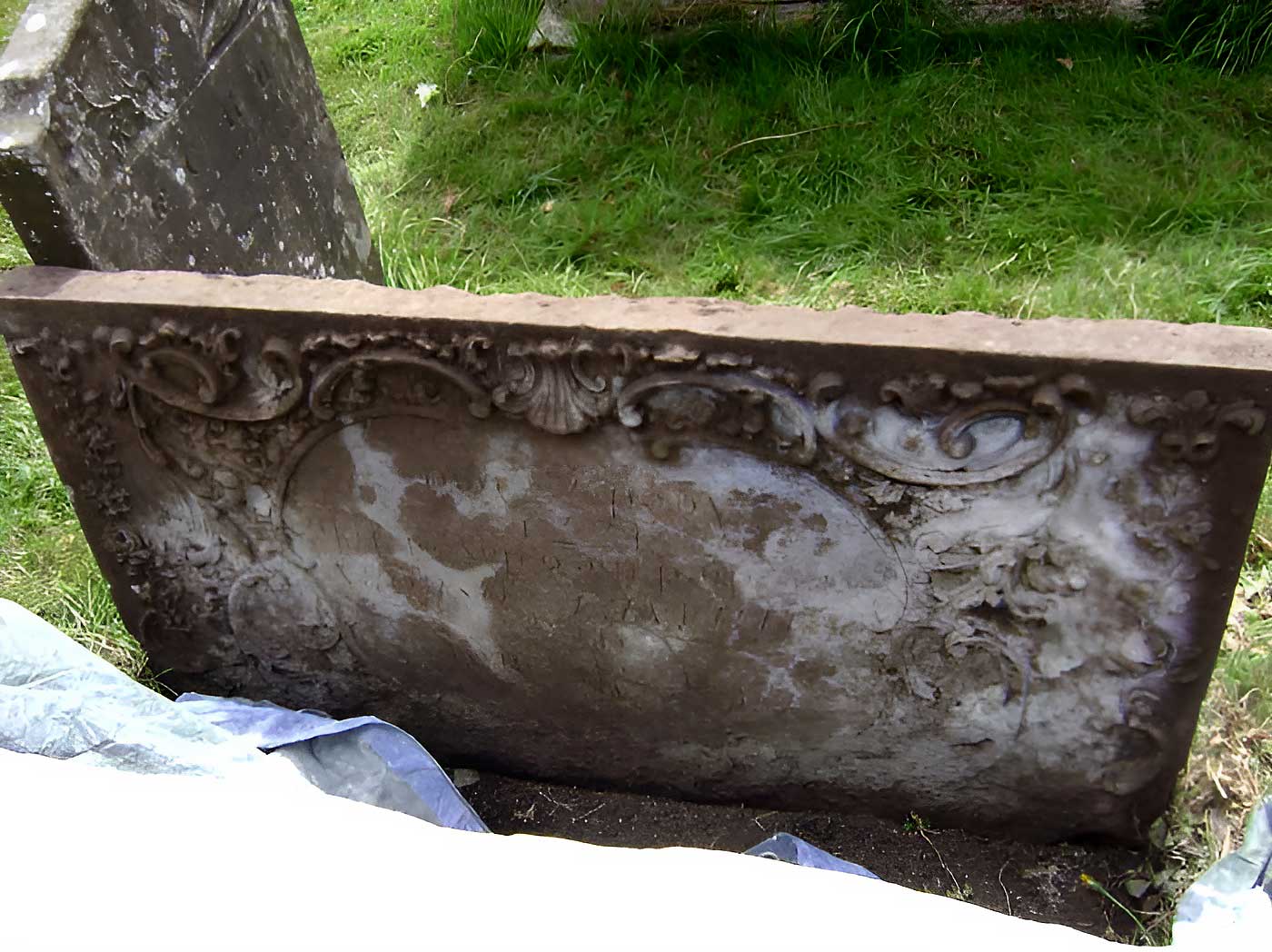
Tomb 1 - work in progress
Carving and inscription preserved on the side lifted from the ground.
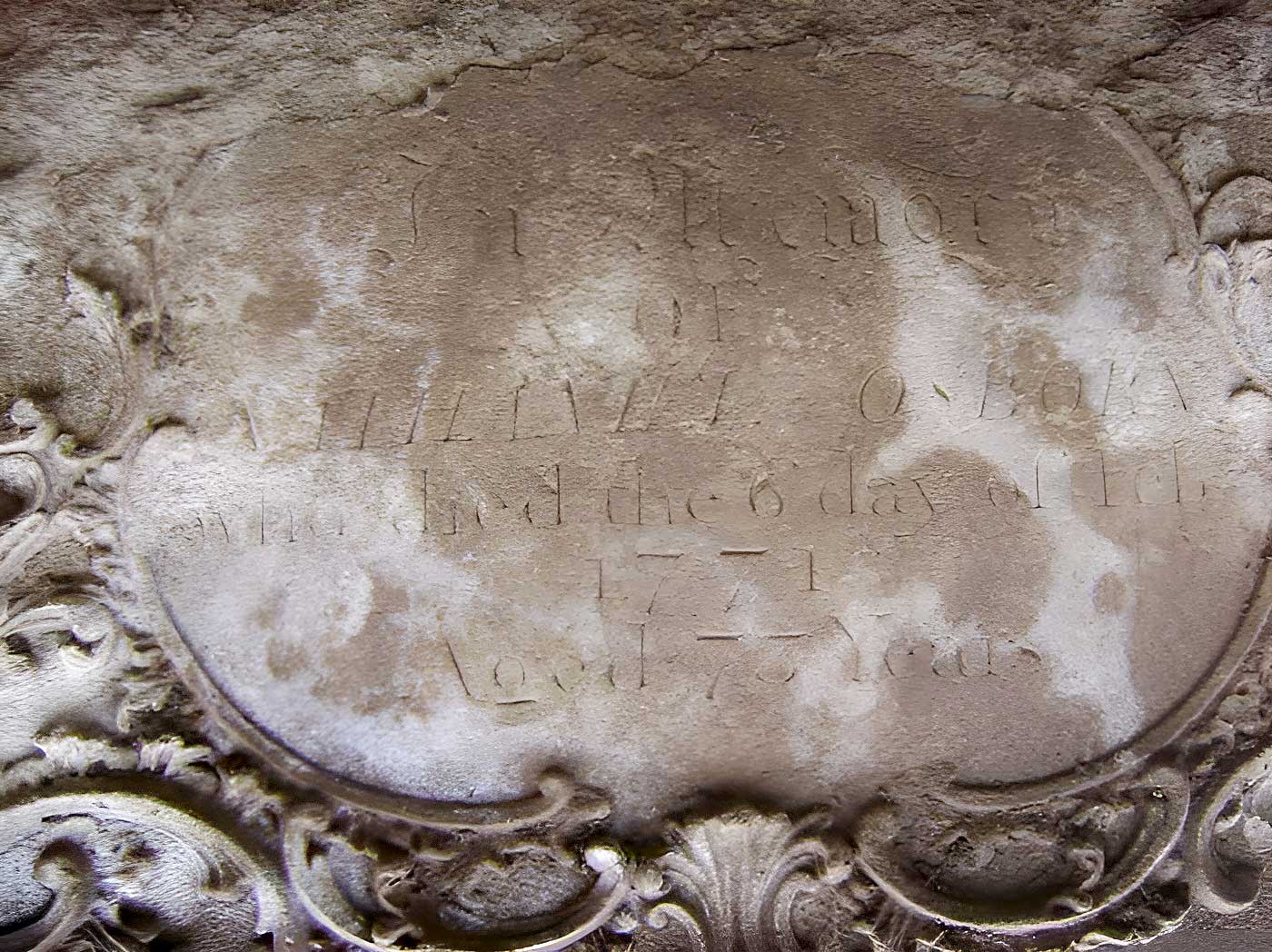
Tomb 1 - work in progress
Inscription on the underside lifted from the ground reads In Memory of Nathanial Osborn who died the 6 day of Feb 1771 Aged 73 Years.
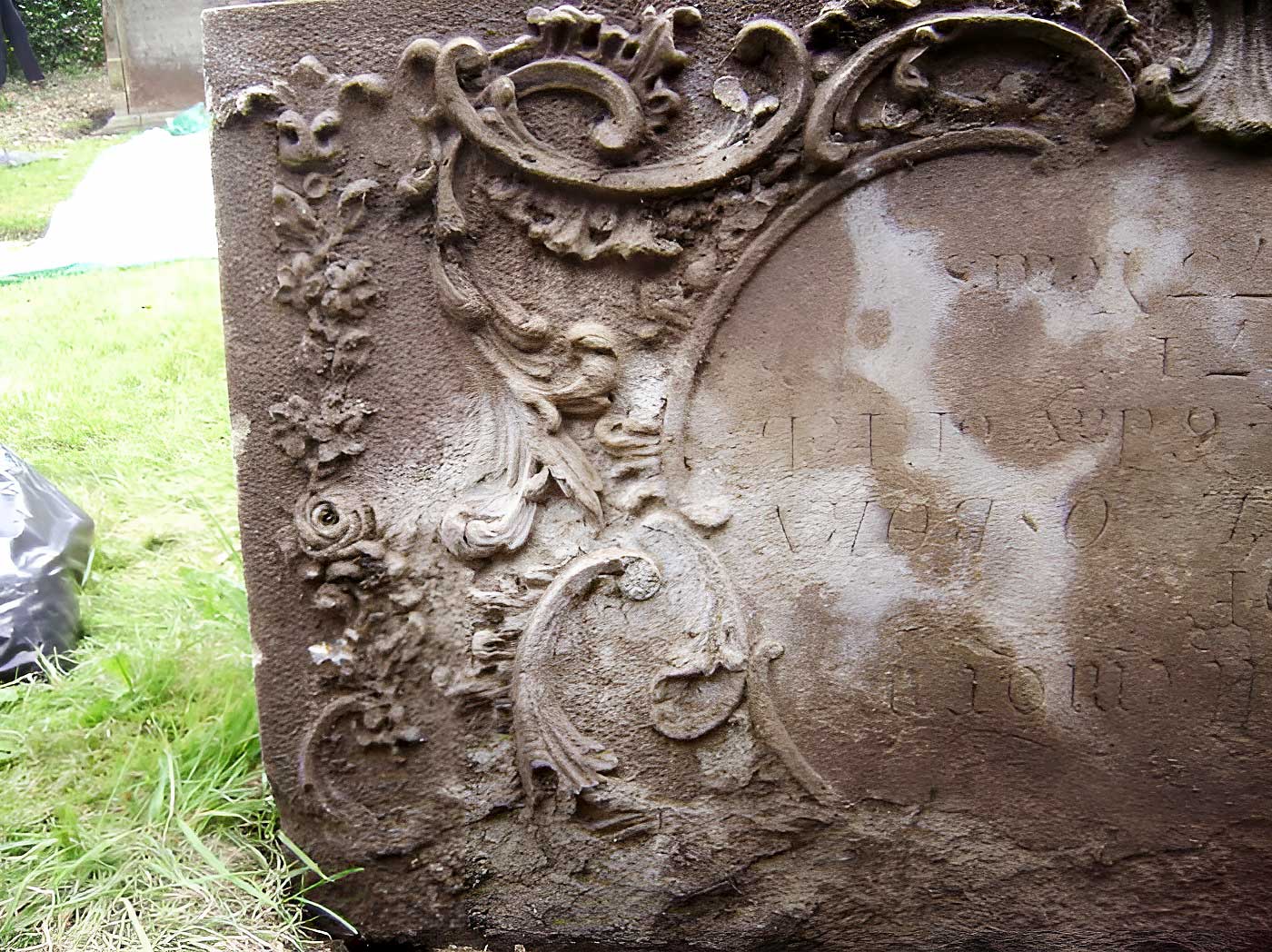
Tomb 1 - work in progress
Carving detail.
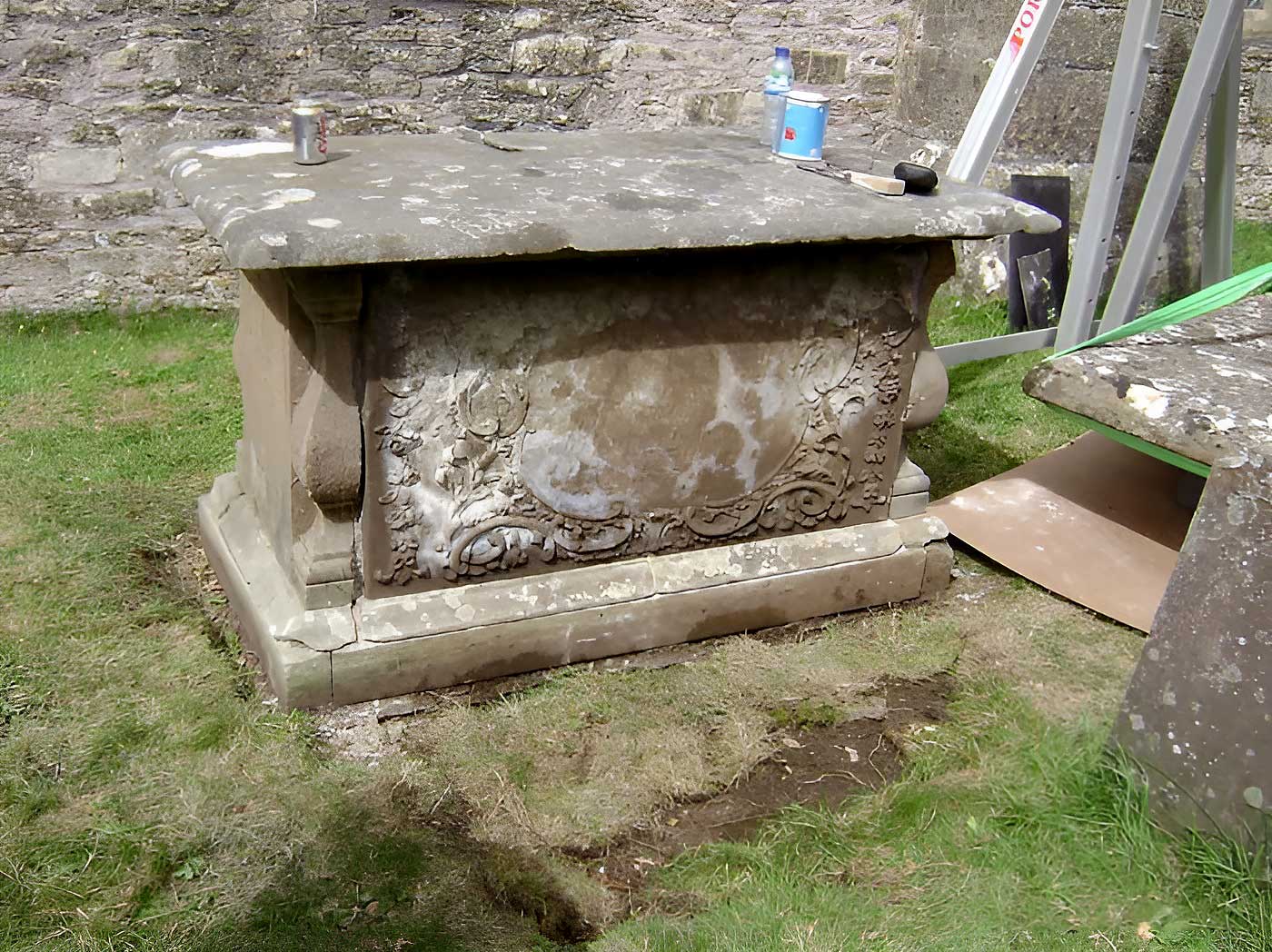
Tomb 1 - work in progress
Tomb reassebled.
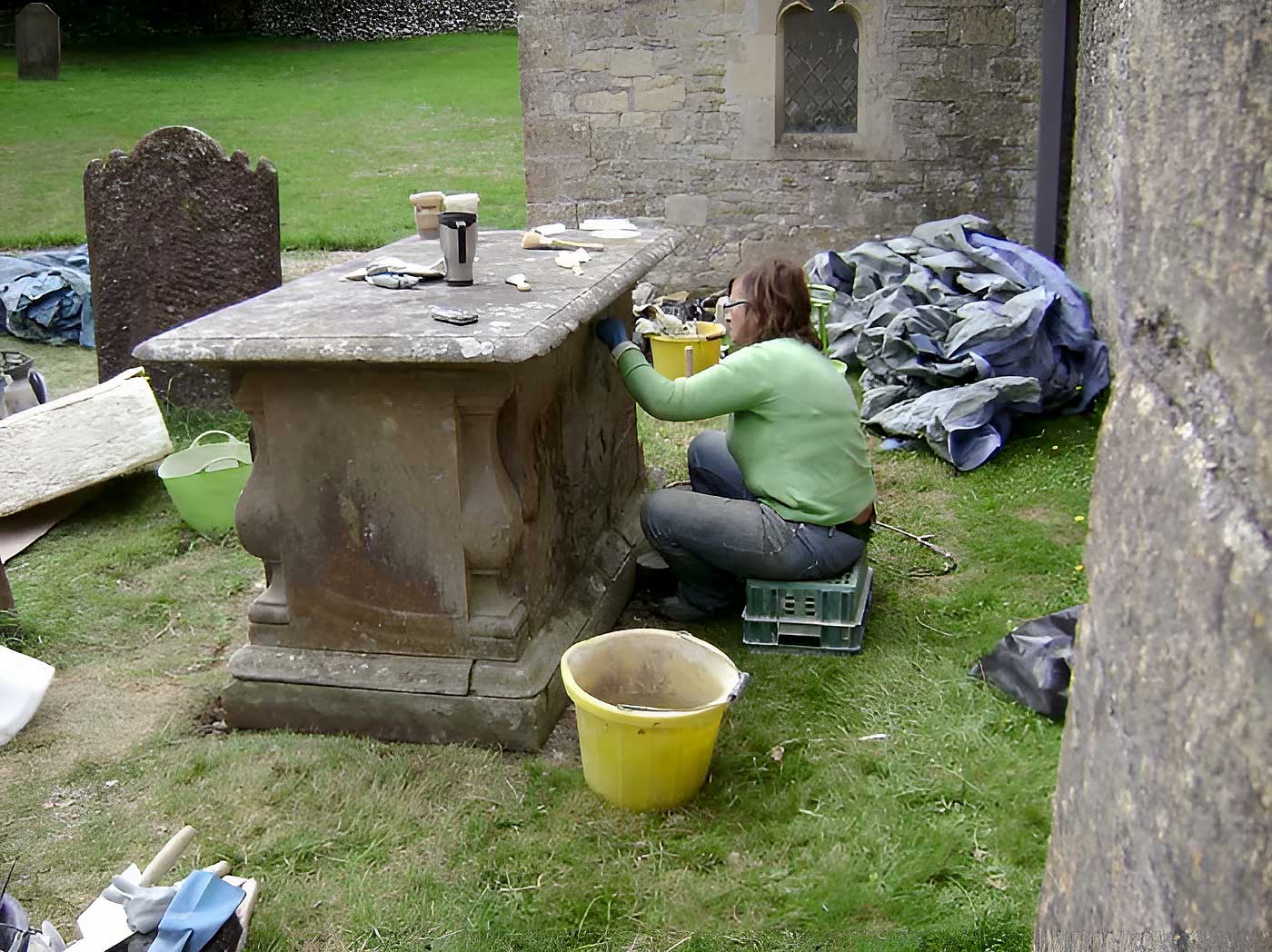
Tomb 1 - work in progress
Filling work on the delaminated panel underway.
Tomb No.2
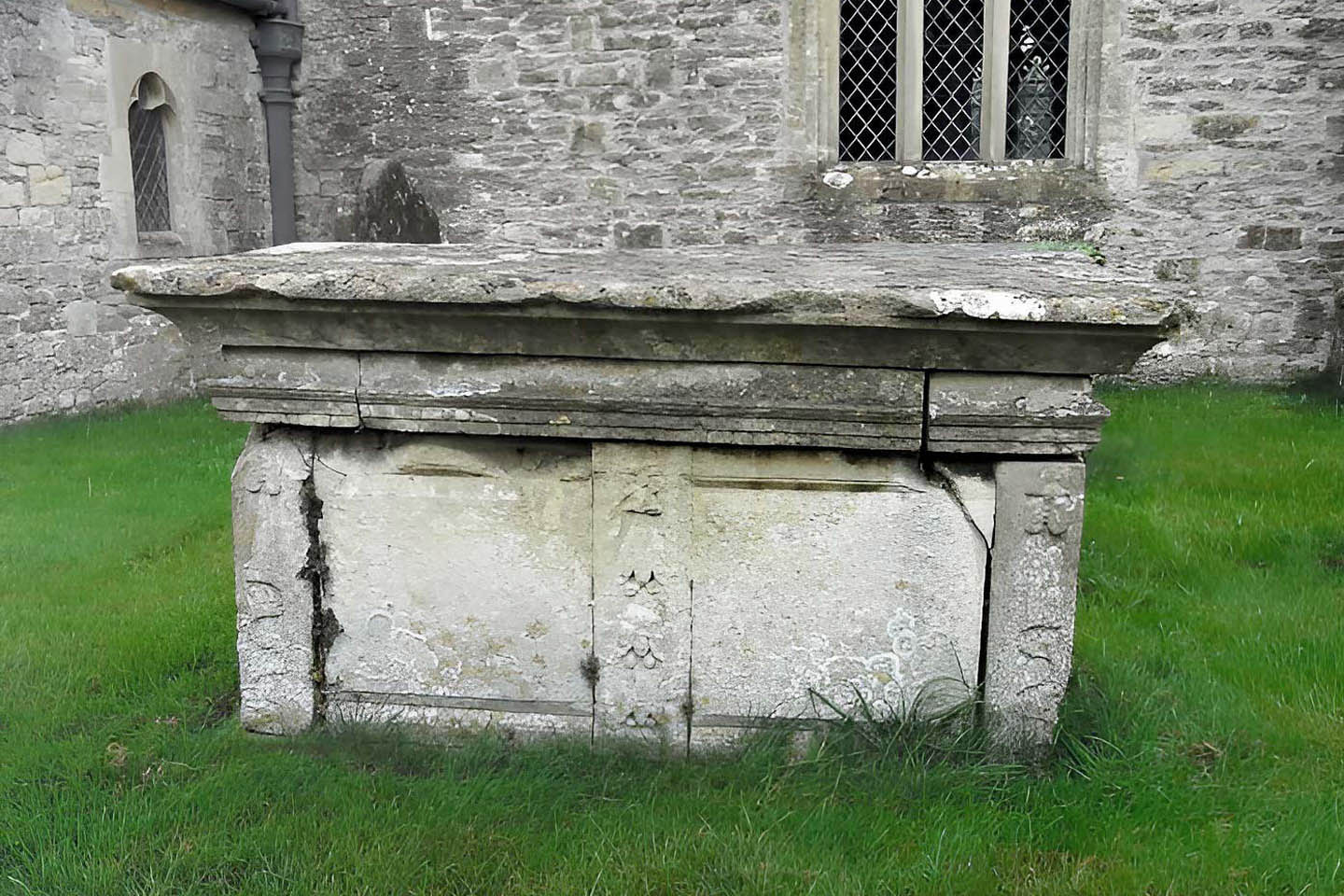
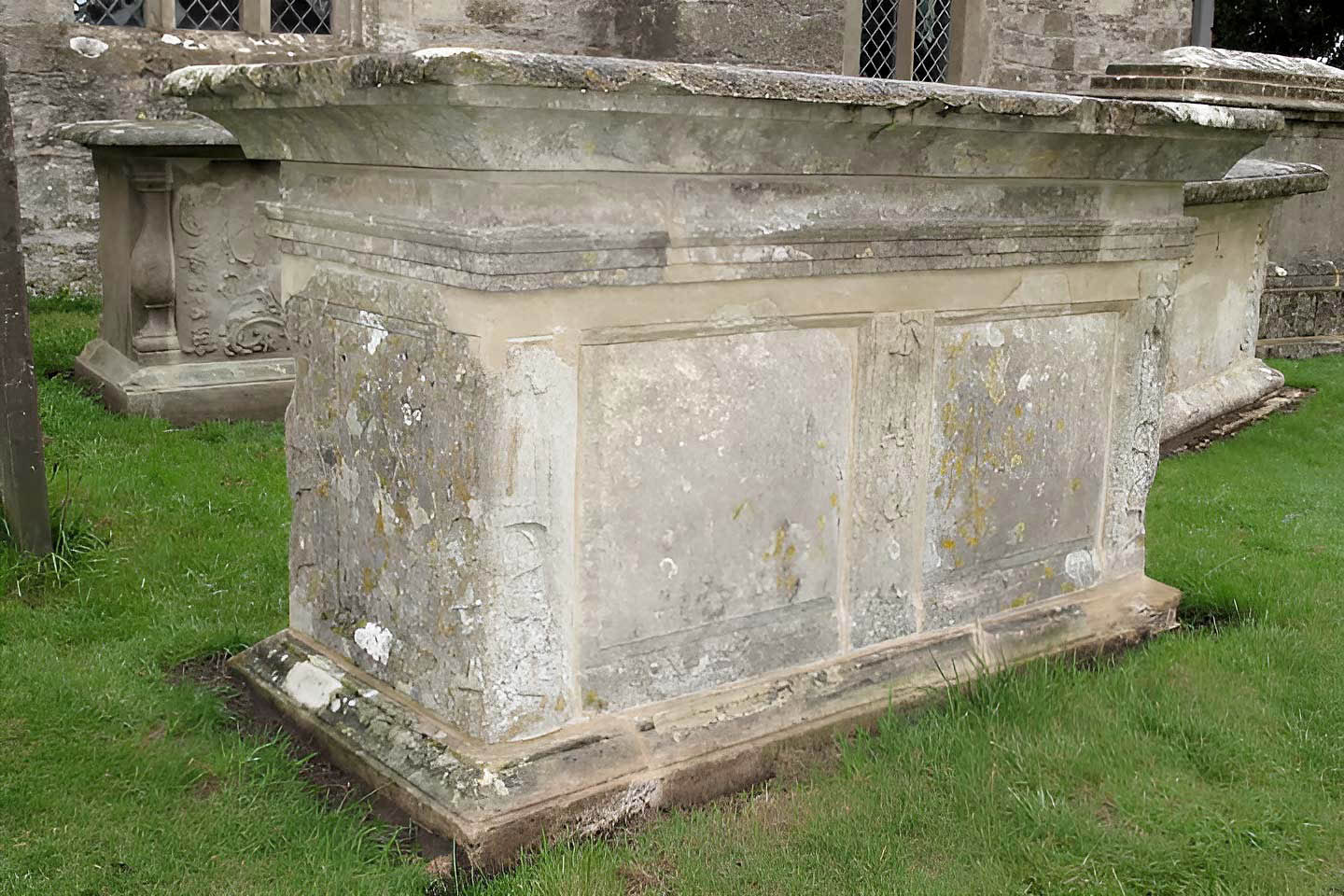
An 18th Century table top tomb in oolitic limestone (Listed Grade II Ref 6/300) with a thick, moulded lid supported by a heavily moulded cornice course of four stones. The ends have drapery bordered plain inscription panels and the south and north sides each have two square panels with frame mouldings top and bottom and a small central pilaster decorated with a margent of drooping flowers. The main decay affecting this tomb was caused by the iron cramps located in the top of the side and end panels. These had rusted and expanded with exposure to moisture and had caused the adjacent stone to crack and fall away. This had put the stability of the tomb at risk with only the great weight of the lid causing the sides to remain in situ.
Before
After
Conservation work
Firstly, the turf and soil were cut back around the plinth to ensure that the base of the monument was stable. Loose stones were removed and labelled for later repair. Before dismantling, the condition and stability of the sides was investigated and appeared steady. The lid of the tomb was removed. Very little vegetation was growing inside the tomb but the iron cramps had caused considerable damage leaving very little sound stone to be cramped back together. It was decided to construct a light weight ‘Celcon’ block core in the middle of the tomb to which the sides could be fixed to ensure stability. The tomb was then completely dismantled.
At ground level five foundation stones were laid out with their joints aligned to Roman numeral markers carved on to each stone. The centre was soil and rubble. The ‘Celcon’ core was built directly onto this level foundation and the plinth stones built up around with a hydraulic lime mortar. The side panels were then bedded onto the plinth stones and new cramp notches were carved into sound areas of their tops so that they could be securely tied with stainless steel cramps fixed with epoxy resin to the core. The cornice stones were then bedded on and the lid lifted back into position. Once erected, broken pieces were pinned back into position and lime mortar repairs carried out. The whole tomb was then deep pack pointed and any vulnerable edges repaired. The turf around the base was cut back and a geo-textile liner was placed around all four sides and covered with top soil to reduce future weed growth.
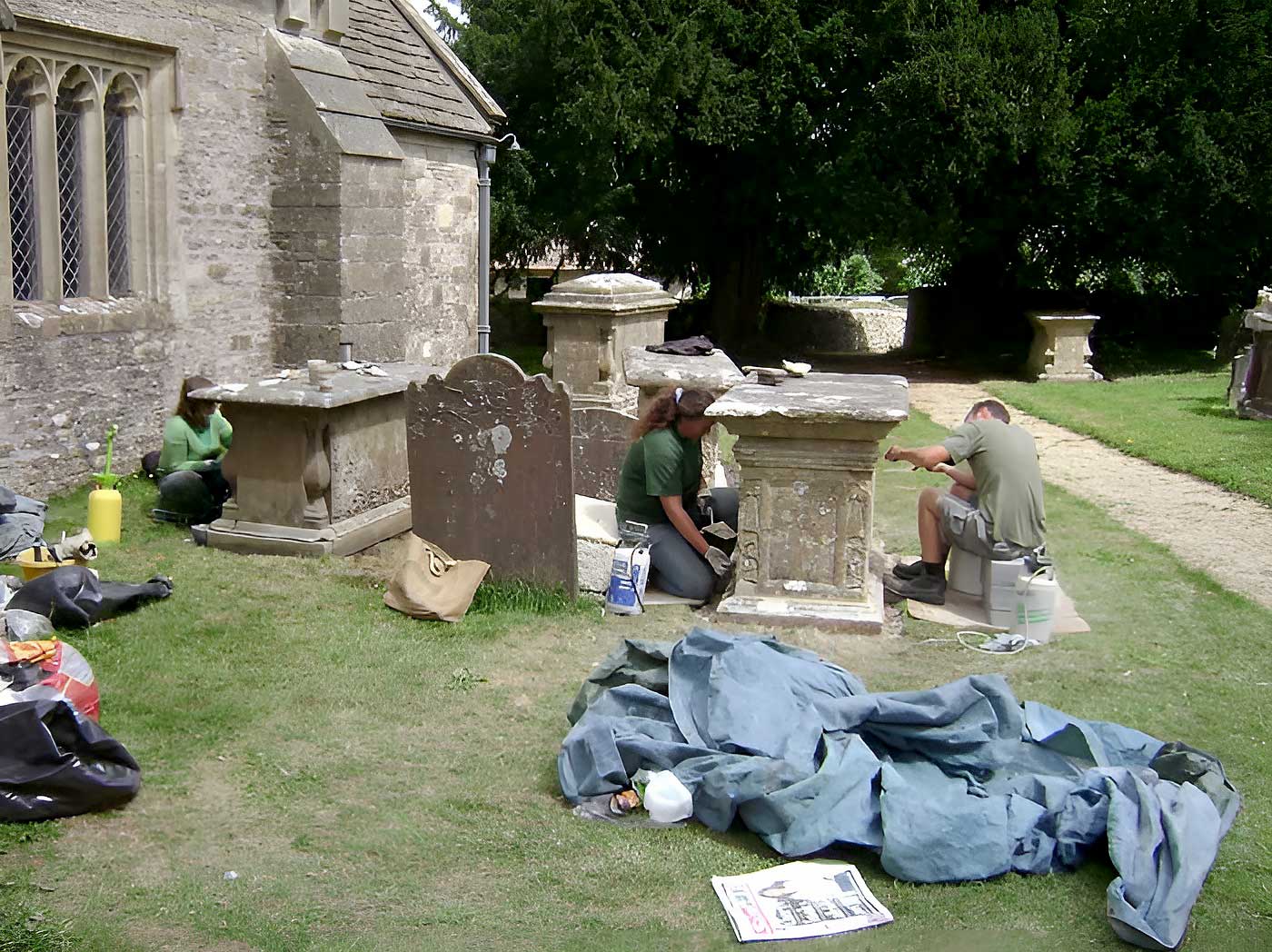
Tomb 1 & Tomb 2
Filling work continuing on tomb 1 and tomb 2.
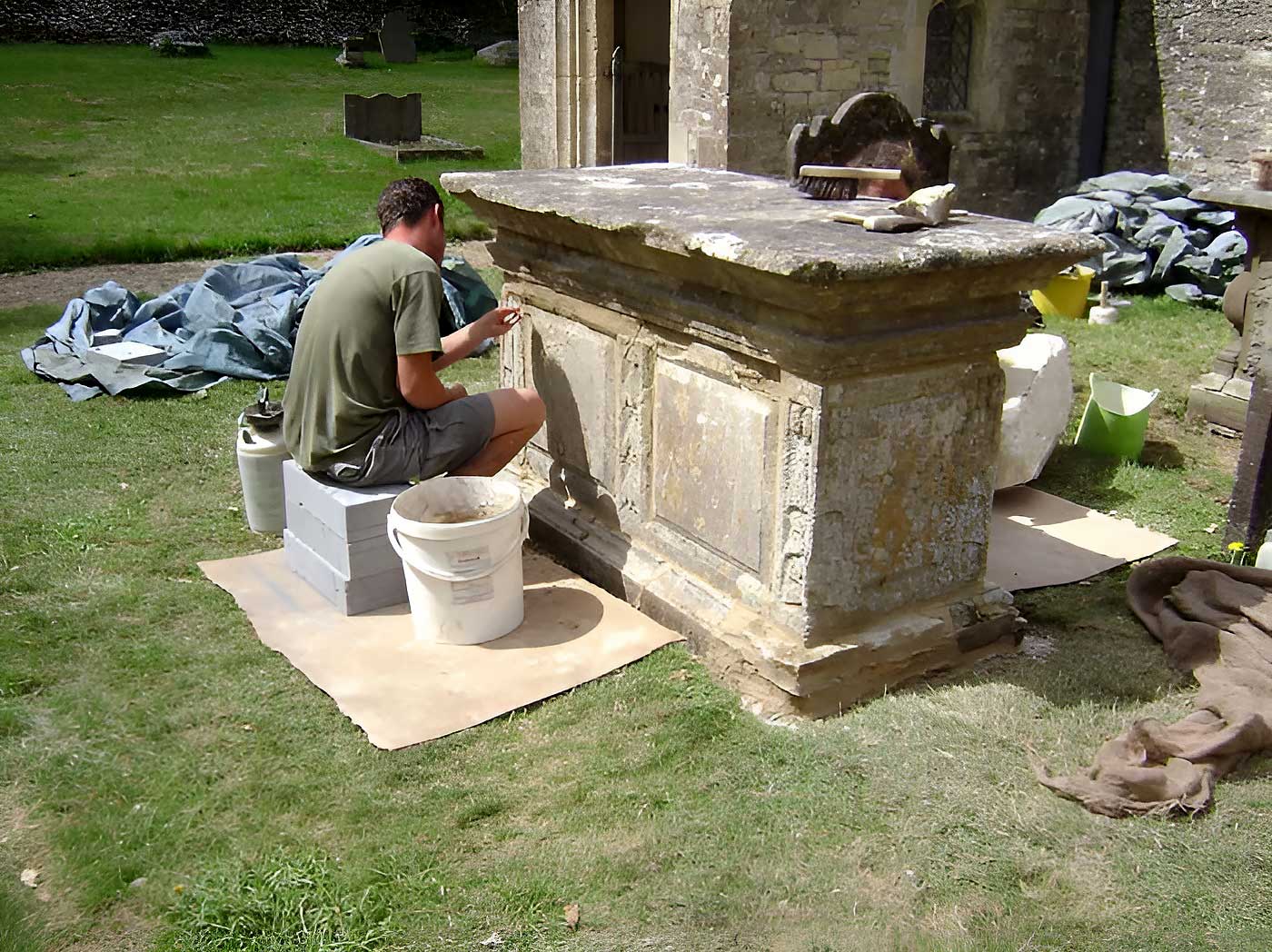
Tomb 2 - work in progress
Filling in progress.
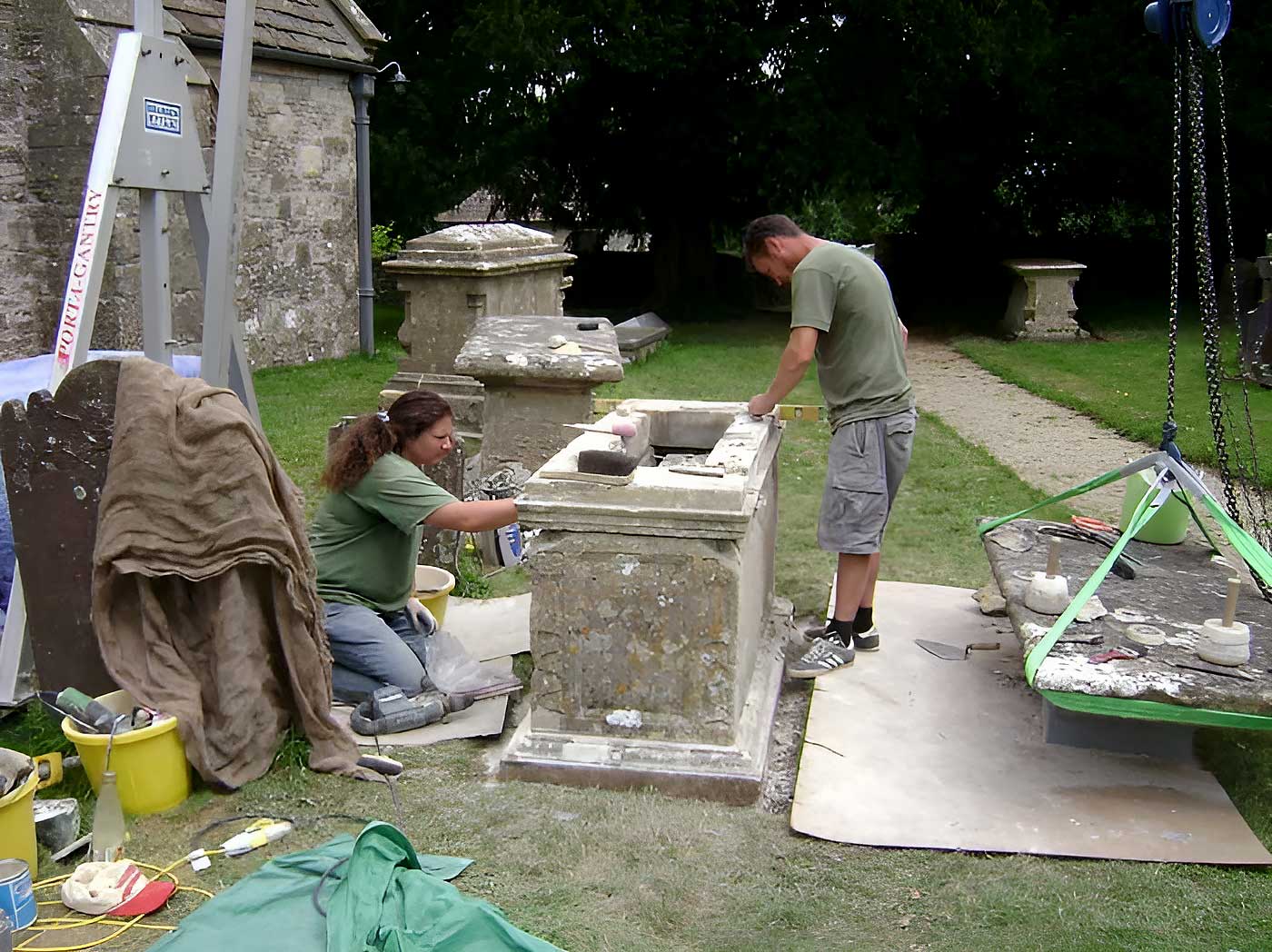
Tomb 2 - work in progress
New ties being installed before replacing top.
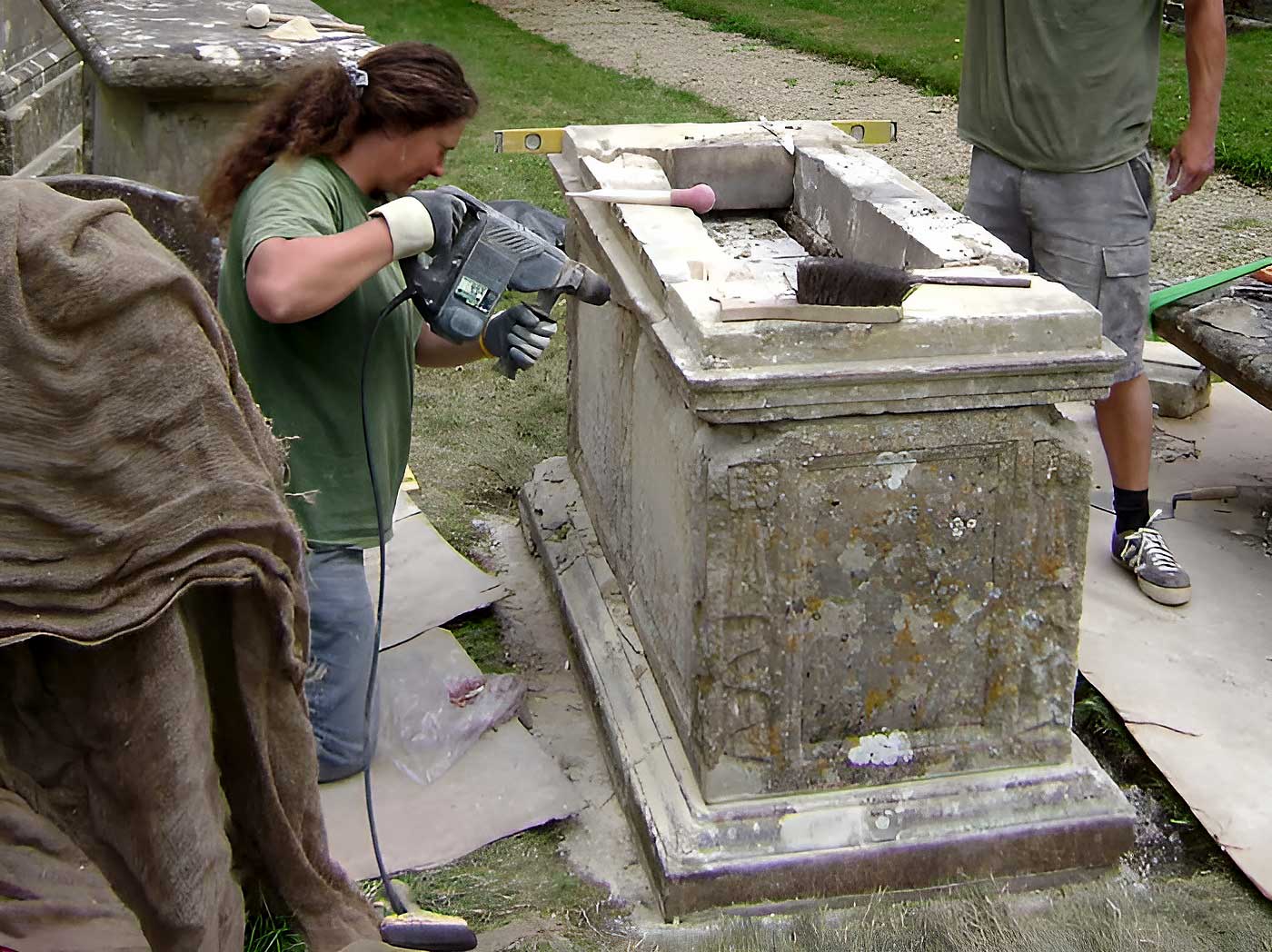
Tomb 2 - work in progress
Tie installation continuing.
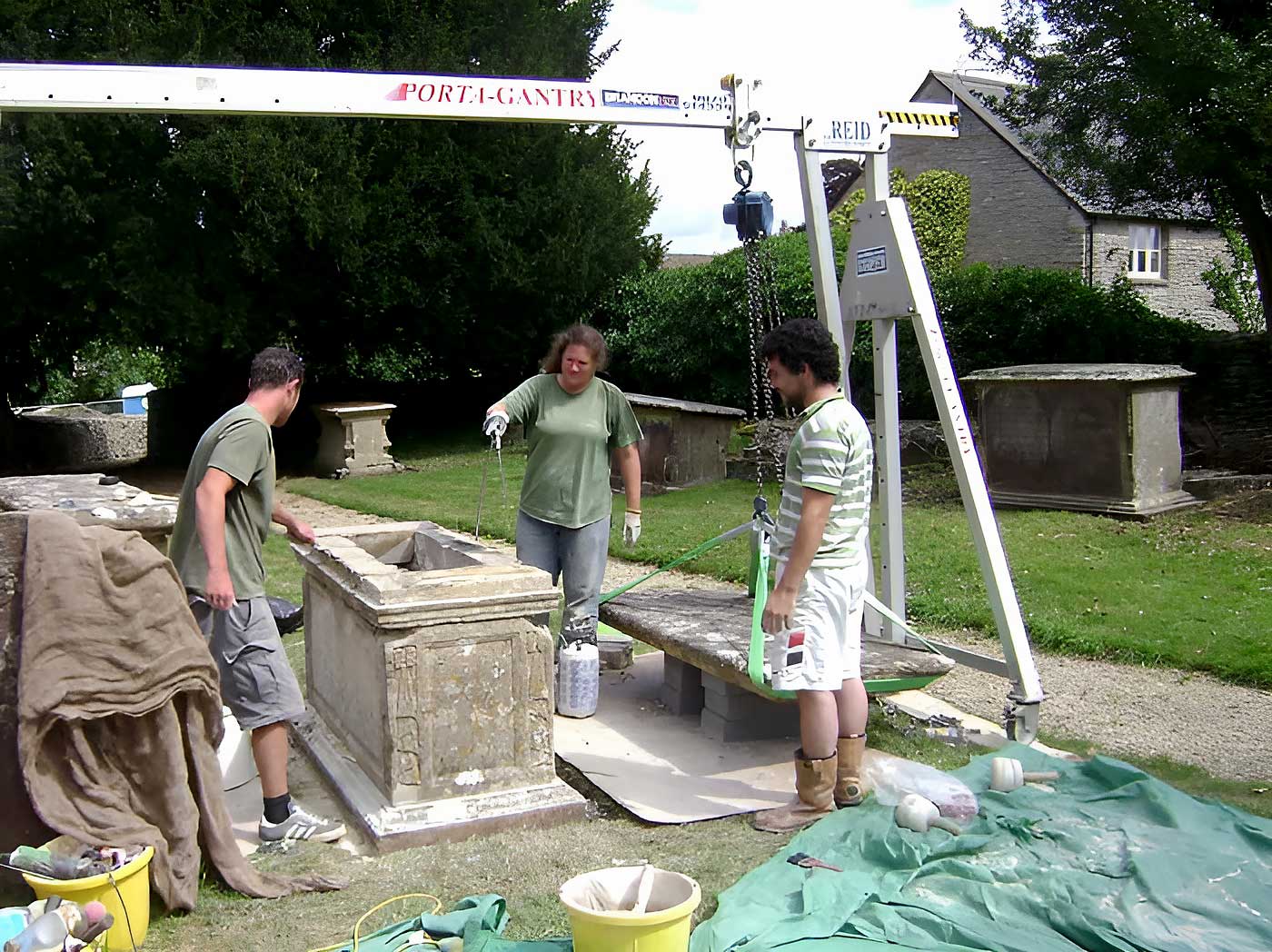
Tomb 2 - work in progress
Preparation for replacing the top slab.
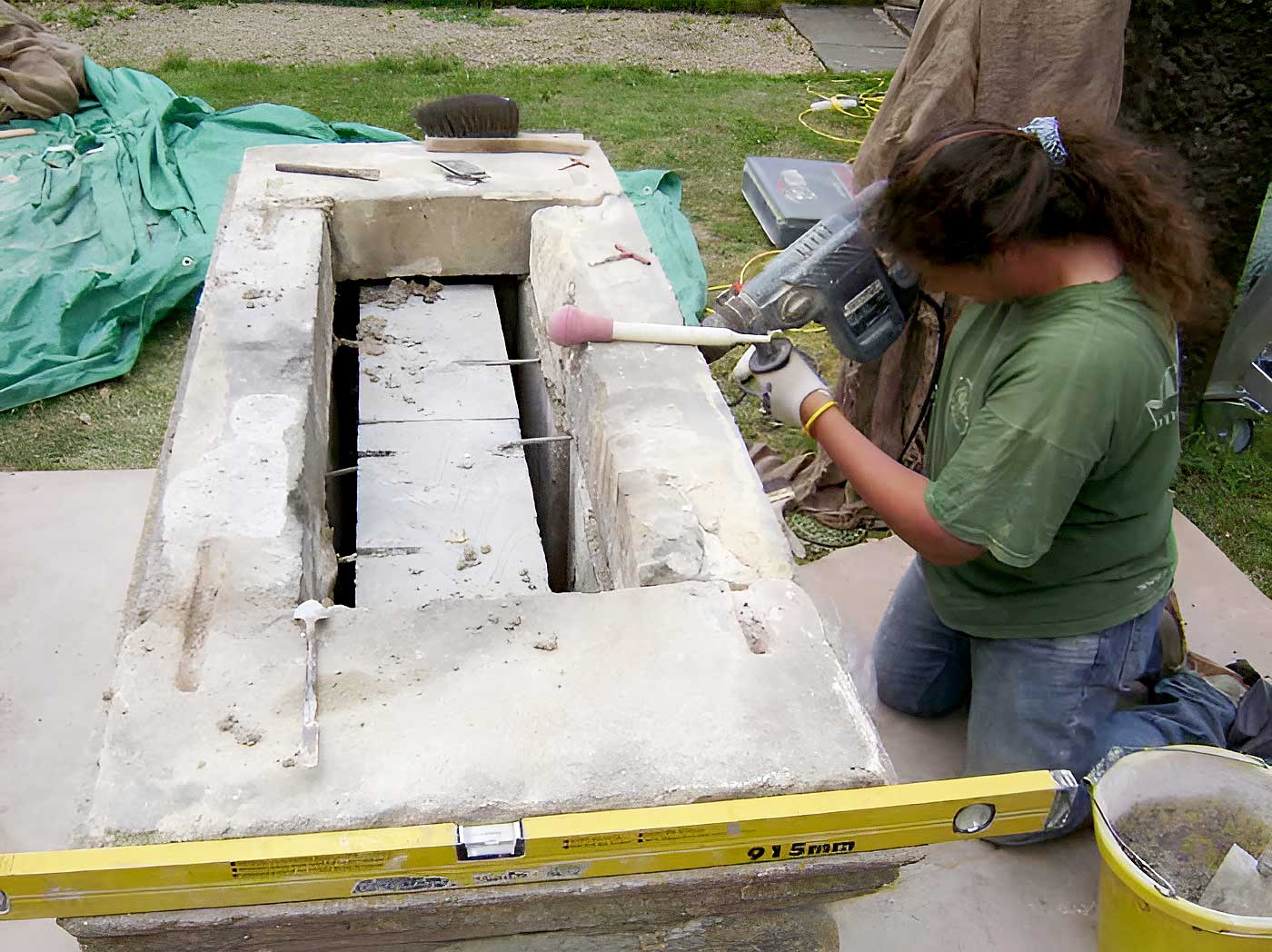
Tomb 2 - work in progress
Blocks and ties inside the tomb to stabilise external slabs.
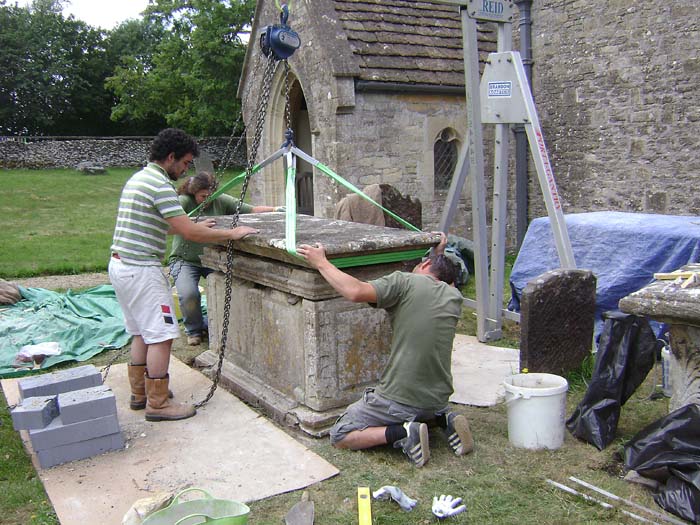
Tomb 2 - work in progress
Top slab being carefully positioned before final installation.
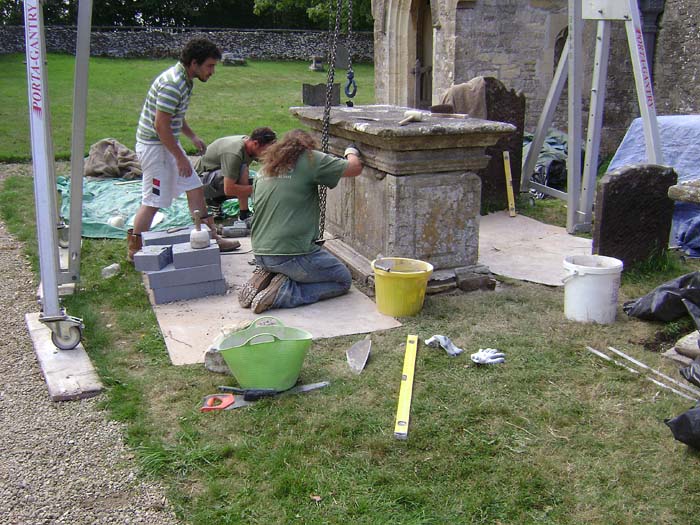
Tomb 2 - work in progress
Filling under top slab after installation.
Tomb No.3
An 18th Century table top tomb in oolitic limestone (Listed Grade II Ref 6/301) with a thick simple moulded top stone sitting on two end panels carved with large foliage sprouting volutes. The north side is a single plain stone with a simple rectangular pilaster down the middle. This stone had a powdery weakened bedding plane running straight through it and a crack at the eastern end. There were also cement repairs at the top corners where iron cramp damage may have occurred in the past. The south panel is in two pieces, the larger decorated with a large volute as the end panels and with foliage buds, while the smaller is bare indicating a possible later replacement. The plinth was in several sections, with a cut out section for a new stone on the east end. The north side was out of line and there was grass and other vegetation growing in the open joints throughout.
Before
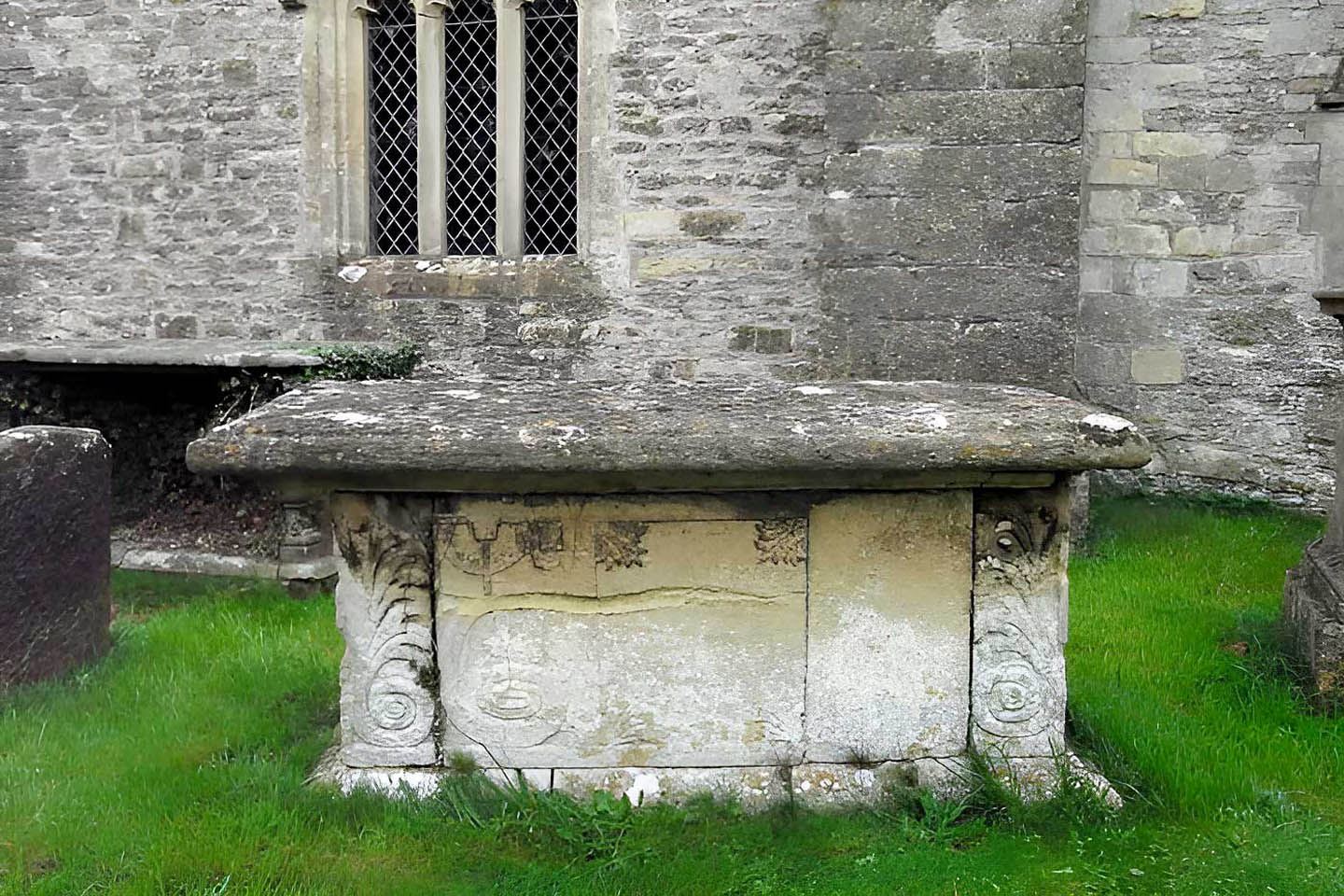
After
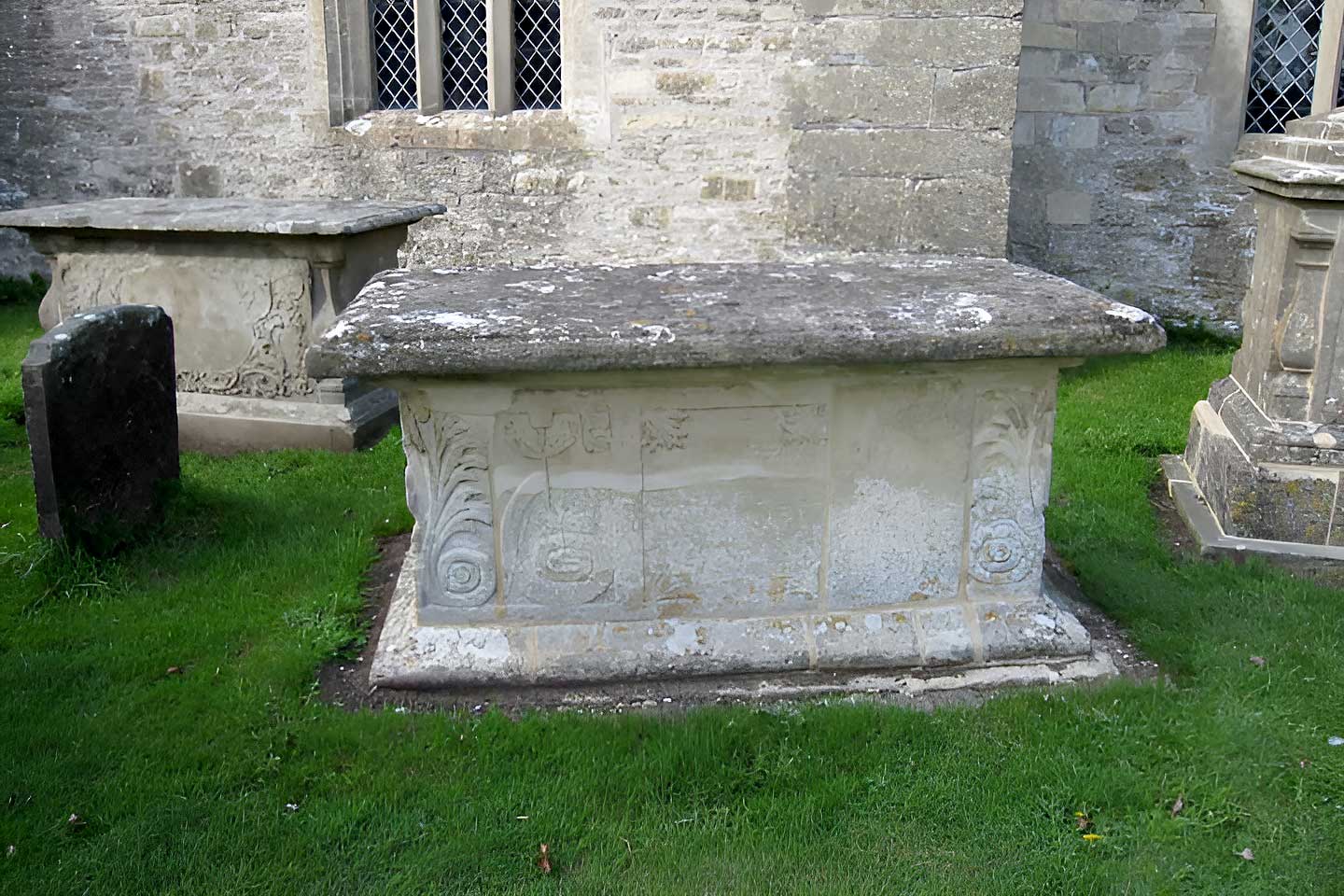
Conservation work
After removing the turf and clearing the vegetation from the joints, the stability of the monument was assessed. The cement repairs were also removed and ferrous cramps were uncovered that had already caused damage to the stone sides. The lid was removed to give access to the ferrous fixings. Before the lid was lifted, three small stone inserts on the north side were carefully removed so that they would not be damaged in the dismantling.
Once the iron fixings were removed and the smaller north panel re-bedded securely, new stainless steel cramps were secured into sound stonework. On the inside face of the north side a crack running along its length was stabilised by drilling across the crack and inserting three stainless steel pins set in resin.
Plinth stones that were out of position were re-bedded as correctly as possible without totally dismantling the tomb. A stone tile repair was inserted at the eastern end to stabilise a frost shattered corner stone. Before resetting the lid all vegetation was removed from the inside of the tomb.
Repointing and mortar repairs were carried out and some black soiling was carefully cleaned with water and soft bristle brushes. The lettering that remained on the north side was carefully consolidated with acrylic resin. A new stone plinth moulding was carved for the cut out check at the eastern end. The turf around the base was cut back and a geo-textile liner was placed around all four sides and covered with top soil to reduce future weed growth.
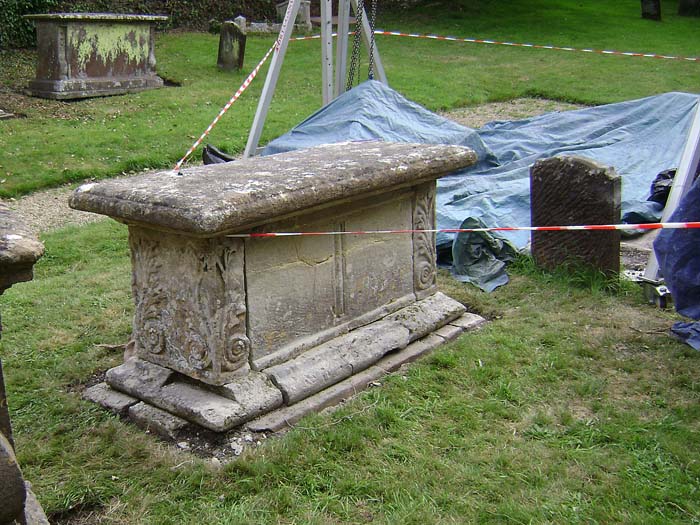
Tomb 3 - work in progress
Base cleaning completed.
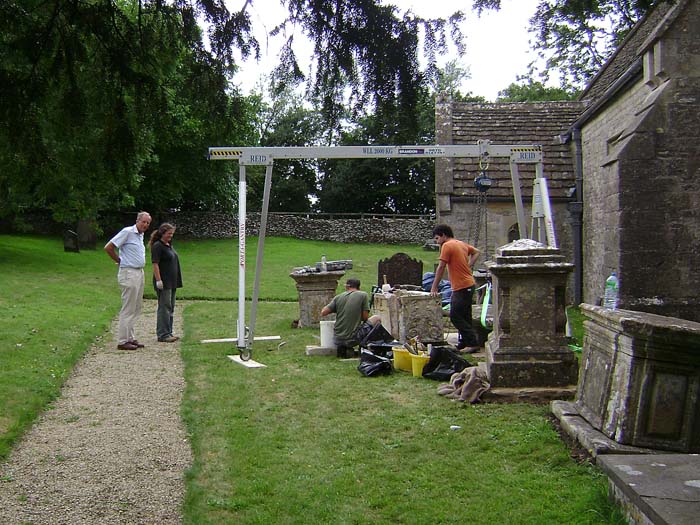
Tomb 3 - work in progress
Top hoisted off for inspection and cleaning.
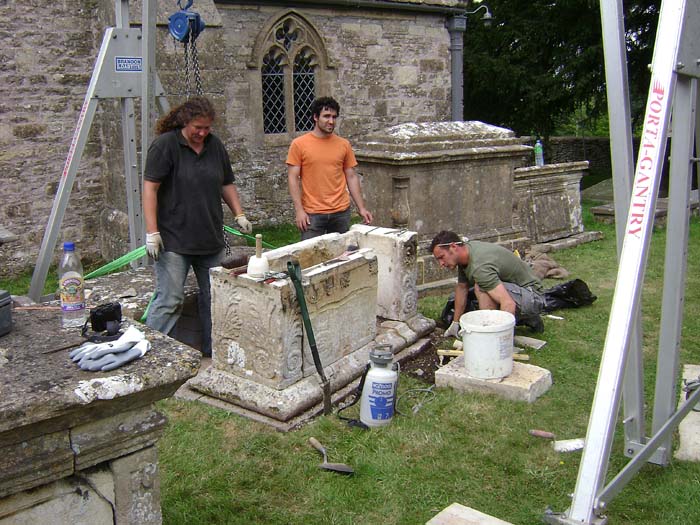
Tomb 3 - work in progress
Cleaning in progress.
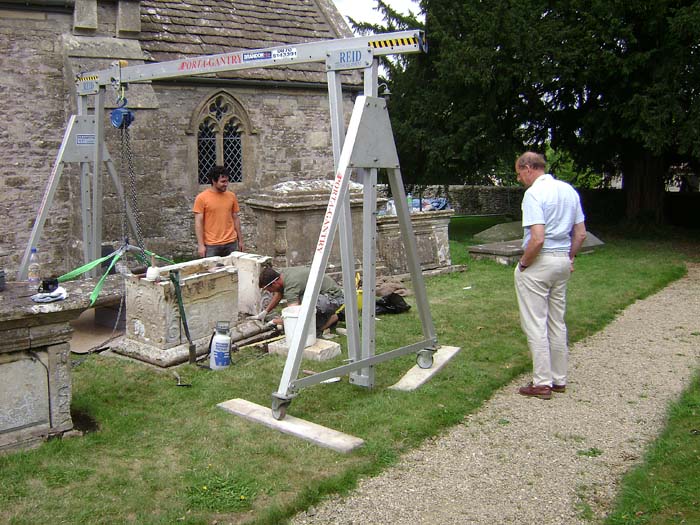
Tomb 3 - work in progress
Base repairs in progress.
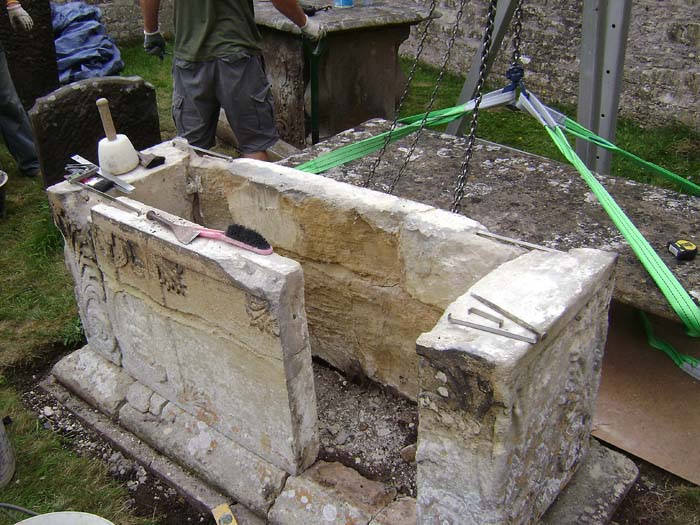
Tomb 3 - work in progress
Preparing for the installation of stainless steel tie bars.
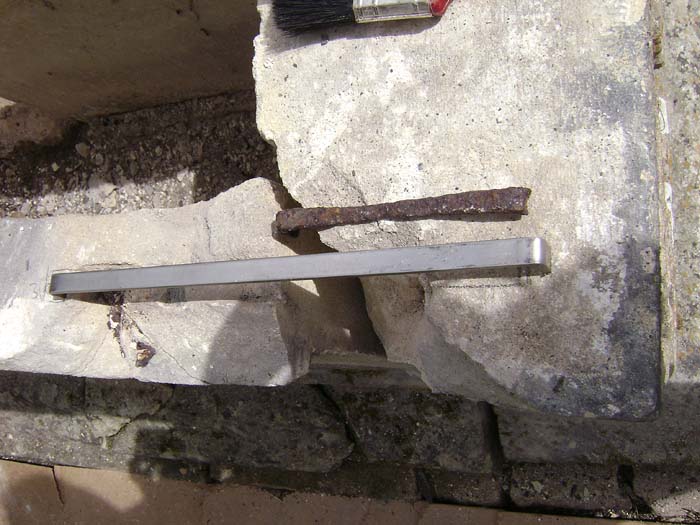
Tomb 3 - work in progress
This is how the new tie bars compare with the old.
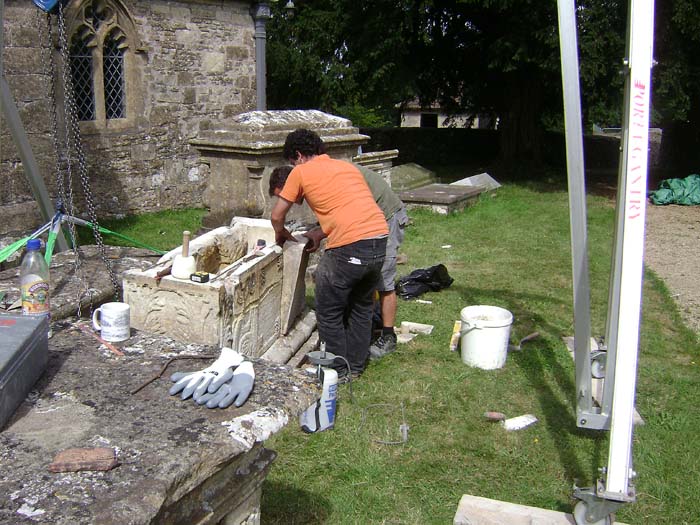
Tomb 3 - work in progress
Reassembly begins.
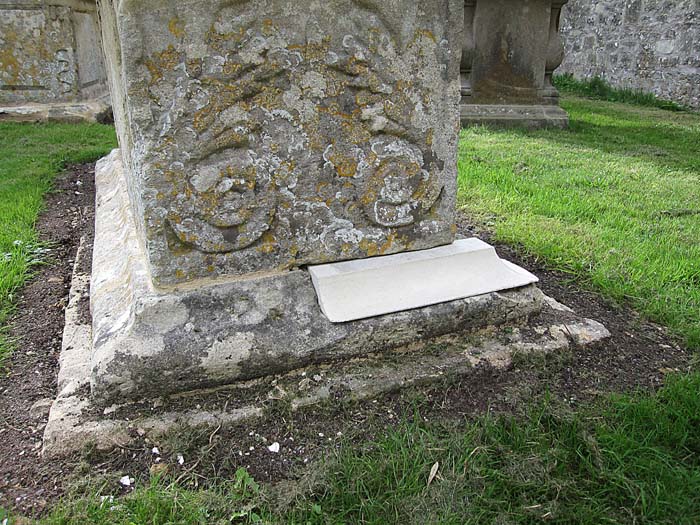
Tomb 3 - work in progress
Final stages of completion of tomb 3. Insert in base moulding ready for finishing.
Tomb No.4
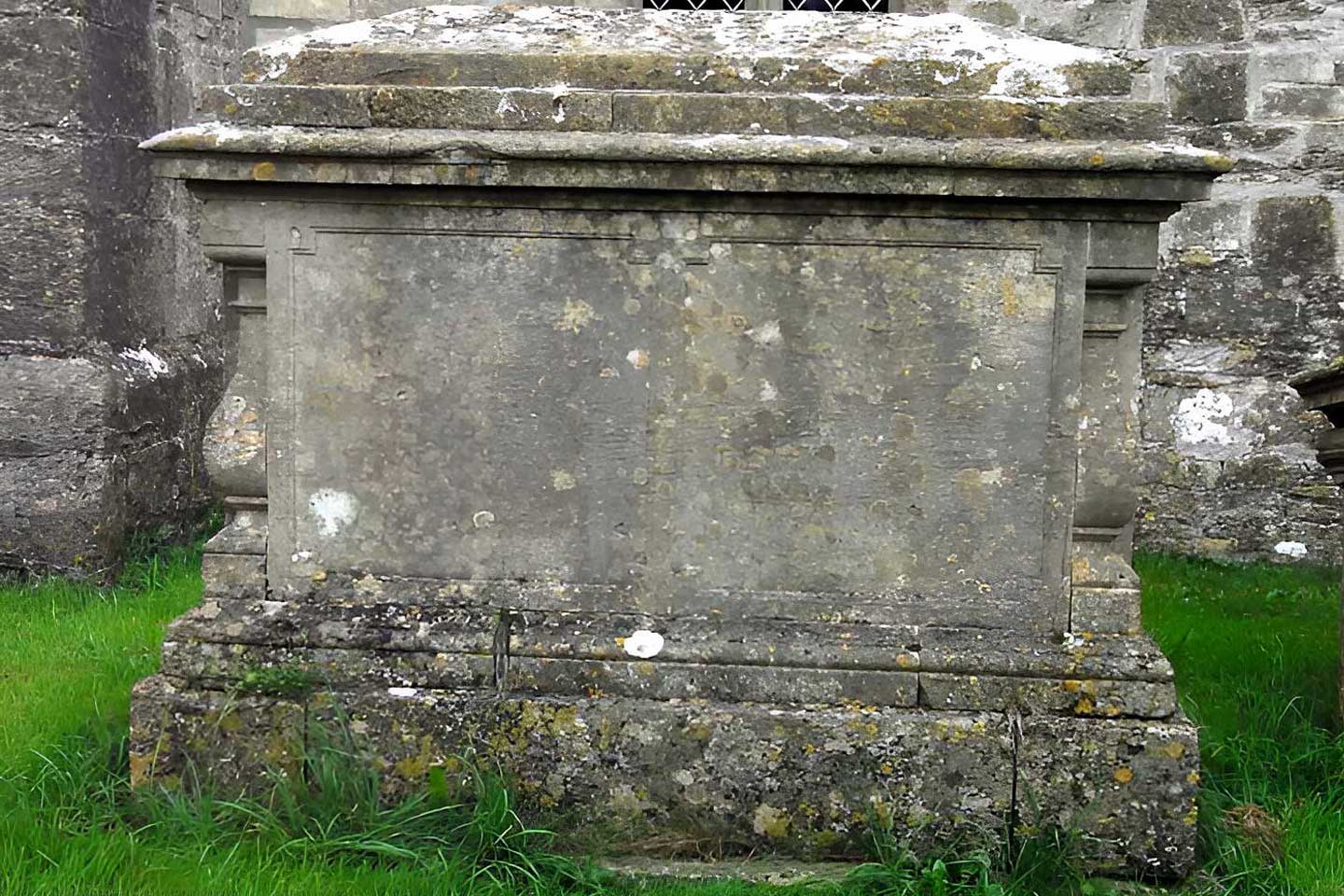
An 18th Century table top tomb in oolitic limestone (Listed Grade II Ref 6/302) with a pyramid shaped lid like a casket with one large stone on the top and a plain course of 6 stones below. The second course below is a sloping cornice which is in 4 pieces. The four side panels consist of two classical balustrade decorated end panels and two large side inscription panels. The base of the tomb is a moulded course above a raised plain plinth on a thin foundation slab. The condition was generally good with only open joints and slight vegetal growth within. However, there was a loose section and a missing section of the lower course of the lid on the south west corner. At the inscription panel level there was a small crack which indicated that the condition of the iron fixing cramp was probably compromised. The base of the north-west corner of the monument was missing with cracks in the plinth.
Before
After
Conservation work
The turf was dug out around the tomb and the foundations exposed to check their condition. All grass and other plant growth was raked out. The lid was lifted and the iron cramps were removed and replaced with stainless steel. The broken part of the lid was mortar repaired as were worn areas on the plinth. The turf around the base was cut back and a geo-textile liner was placed around all four sides and covered with top soil to reduce the future weed growth.
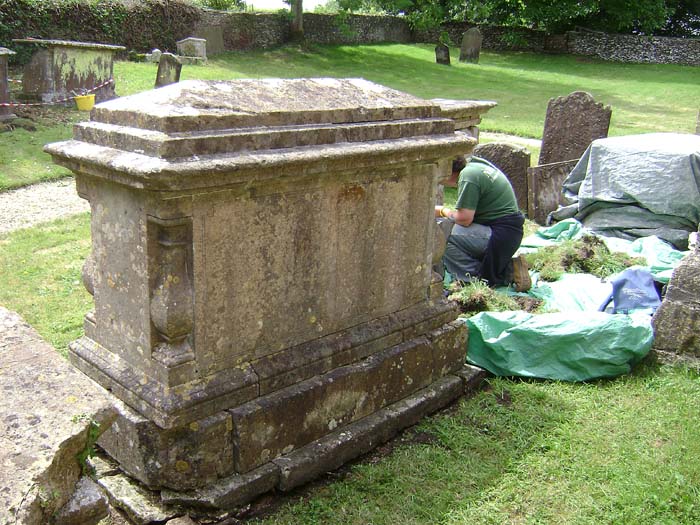
Tomb 4 - work in progress
The condition of the tomb at the start of work.
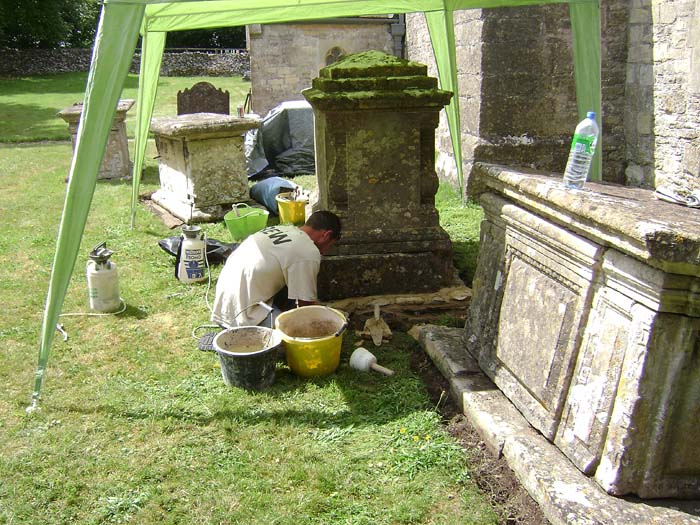
Tomb 4 - work in progress
Filling of the base crevices.
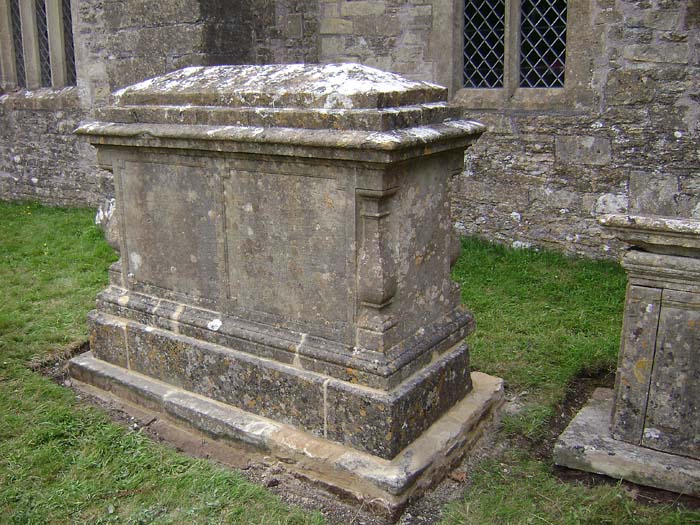
Tomb 4 - work in progress
The tomb base cleaned and filled.
Tomb No.5
An 18th Century table top tomb in oolitic limestone (Listed Grade II Ref 6/303) with a heavily moulded lid with a broken corner. The mouldings are stepped on all four sides to align with the stepped moulded cornice. The cornice is in four sections. The end panels have drooped flower margent decorations on the edges and chamfered inscription panels framed with an egg and dart motif. The larger north and south panels are stepped with two plain fielded side panels and an egg and dart framed central one. The plain plinth stones were out of line because the tomb was leaning steeply to the north. Ivy and grass was growing in the joints of the tomb whilst the north side was half covered in black soiling. The corners of the inscription panel on the north side were cracked and broken where the iron fixings had rusted and expanded. Cement pointing had been used to patch up the tomb.
Before
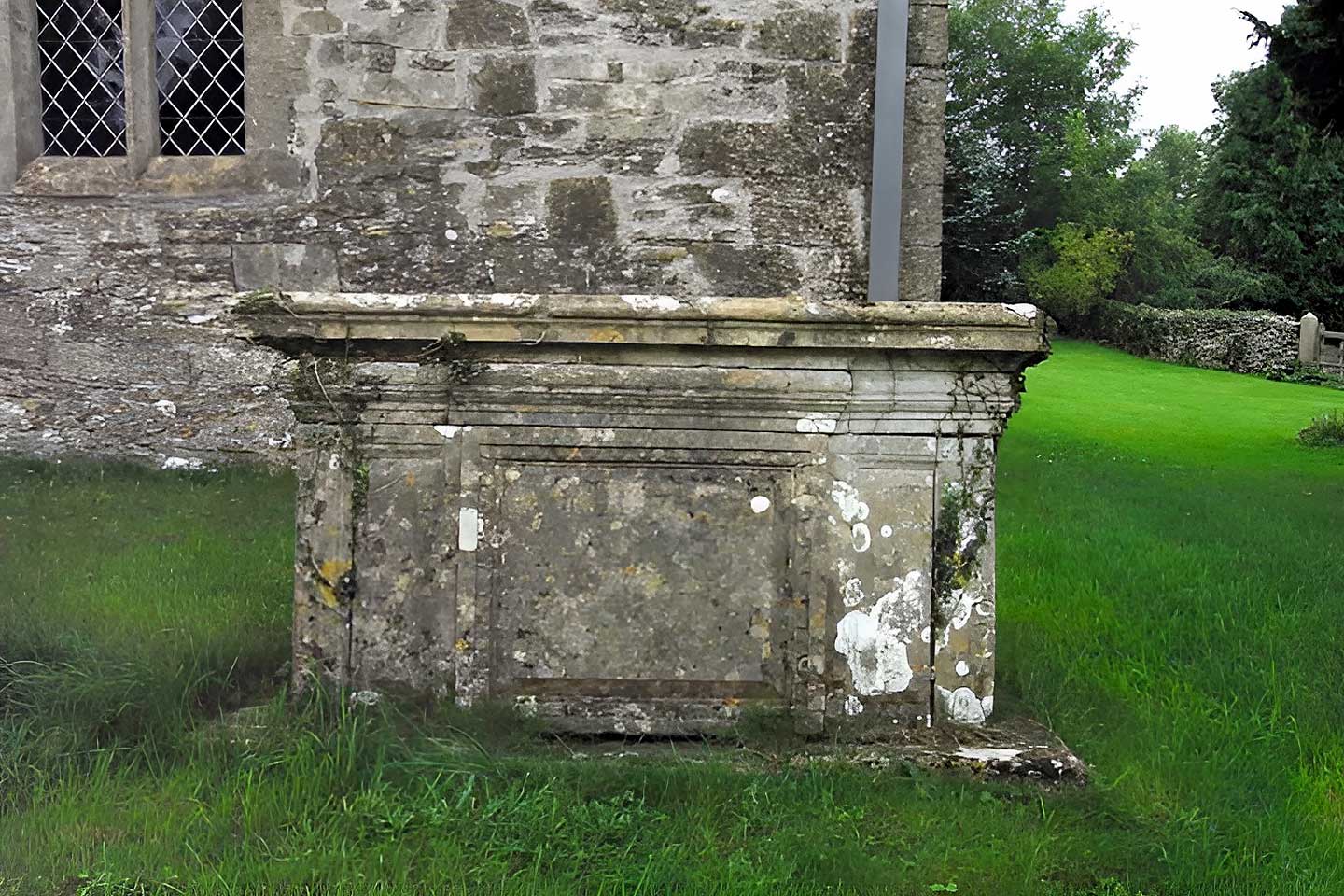
After
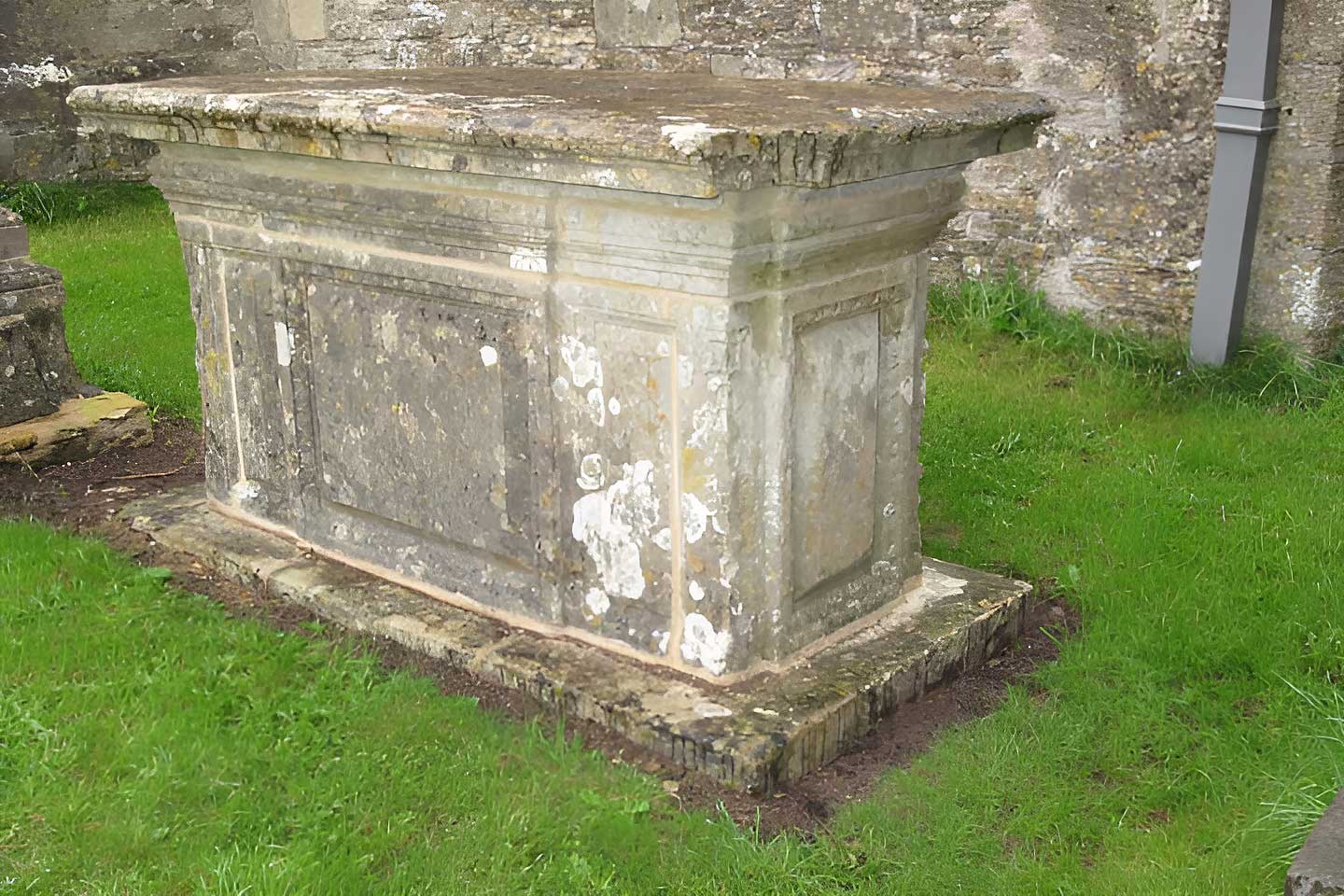
Conservation work
Firstly, the turf and the vegetation from the joints were cleared around the tomb and the stability assessed. The tomb was then strapped to hold the sides together whilst the top was lifted off. Iron cramps were removed from the cornice course and the tops of the panels. Once the cramps and cornice were removed, the straps were carefully loosened to lift away the side panels.
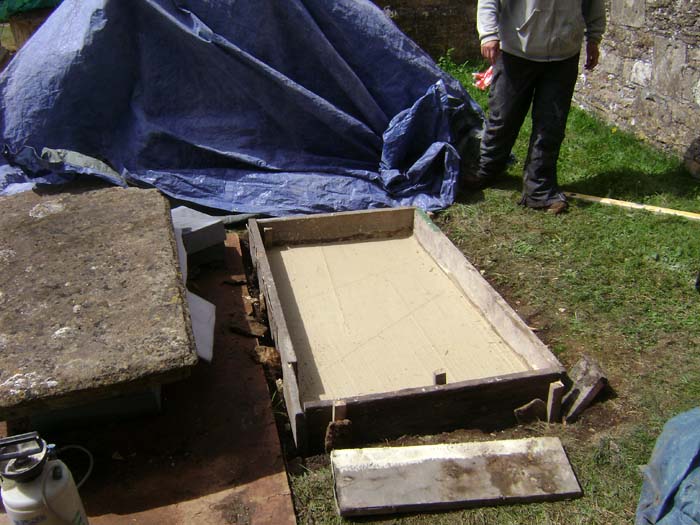
Once dismantled, the ground was levelled out. No subsidence was visible but it was felt necessary to lay a hydraulic (NHL5) lime concrete foundation onto which the large foundation stones were re-laid. However, no core was needed because the foundation and plinth stones were so large.
The tomb was rebuilt using stainless steel cramps. It was then repointed and repaired using a hydraulic mortar. The remaining lettering on the north side was carefully cleaned with water and soft bristle brushes and then consolidated with 10% Paraloid acrylic resin. The turf around the base was cut back and a geo-textile liner was placed around all four sides and covered with top soil to reduce future weed growth.
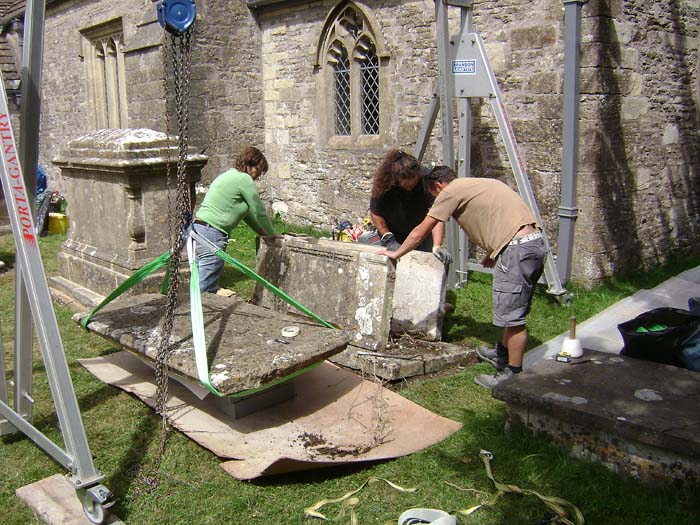
Tomb 5 - work in progress
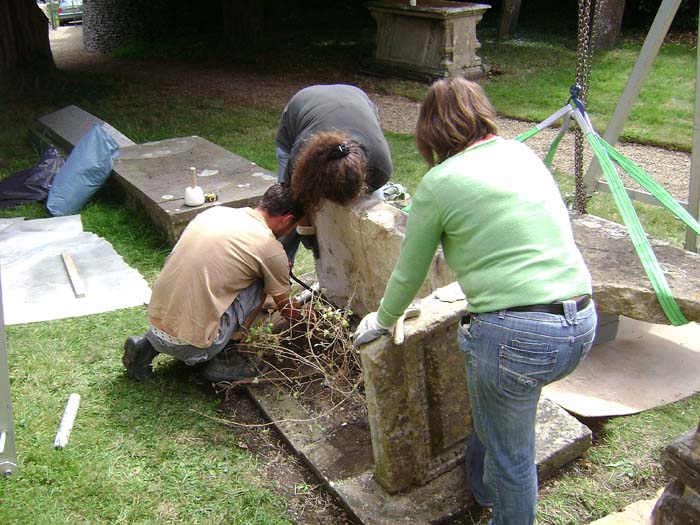
Dismantling the tomb.
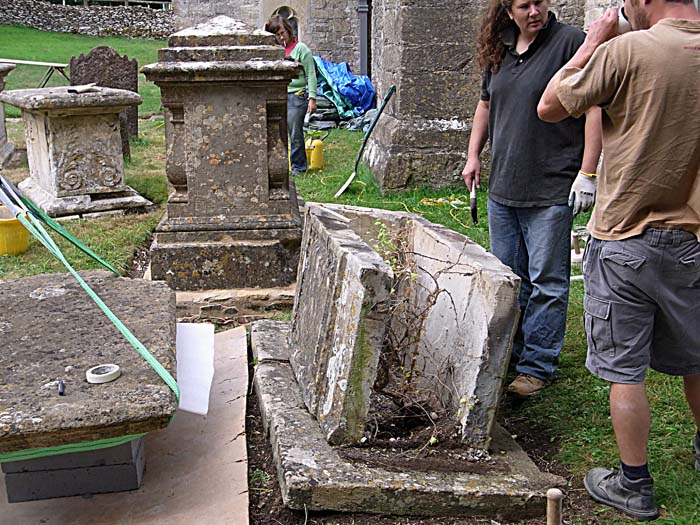
Tomb 5 - work in progress
Mind your toes ..... how is this for a jazzy angle!
Tomb 5 - work in progress
Dismantling in progress.
Tomb 5 - work in progress
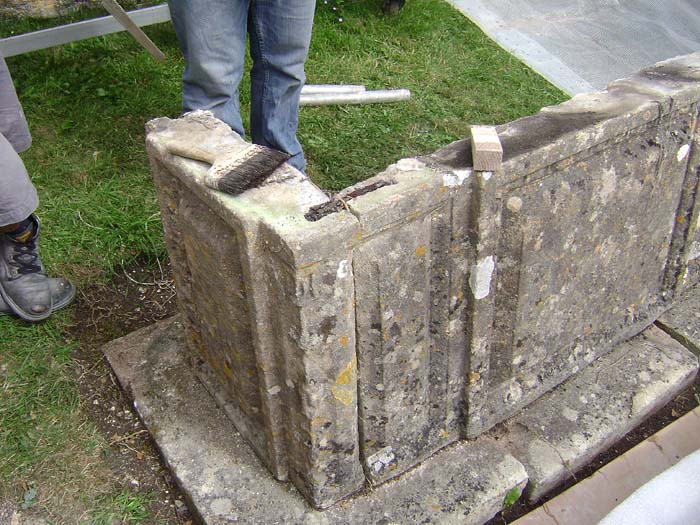
Rusting iron tie in the tomb.
Tomb 5 - work in progress
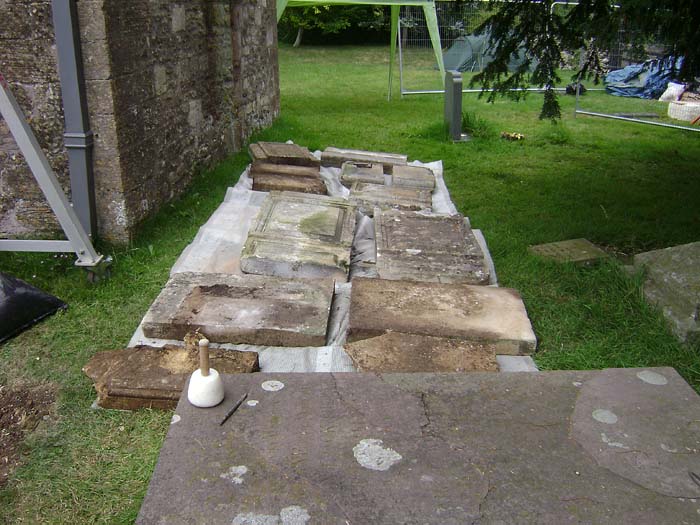
All parts laid out after total dismantling.
Tomb 5 - work in progress
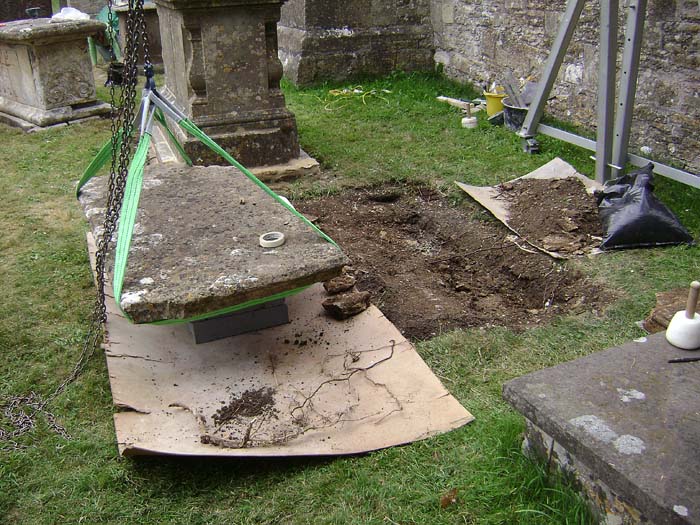
Sunken earth below the base of the tomb.
Tomb 5 - work in progress
New lime concrete foundation for the tomb.
Tomb No.6
An 18th Century table top tomb in fine grained sand stone (Listed Grade II Ref 6/304) with a monolithic lid with a simple moulding on the underside and sitting on the four side panels. The northern side panel has an inscription in a plain central field flanked by a margent of drooping flowers and two plain rectangular panels. The ends are lyre shaped. The plinth is made up of four moulded sandstone elements placed on a vertically tooled foundation stone. The monument had been badly affected by the roots of the nearby yew tree and by ivy. The sides were falling in due to rusted ferrous cramps.
Before
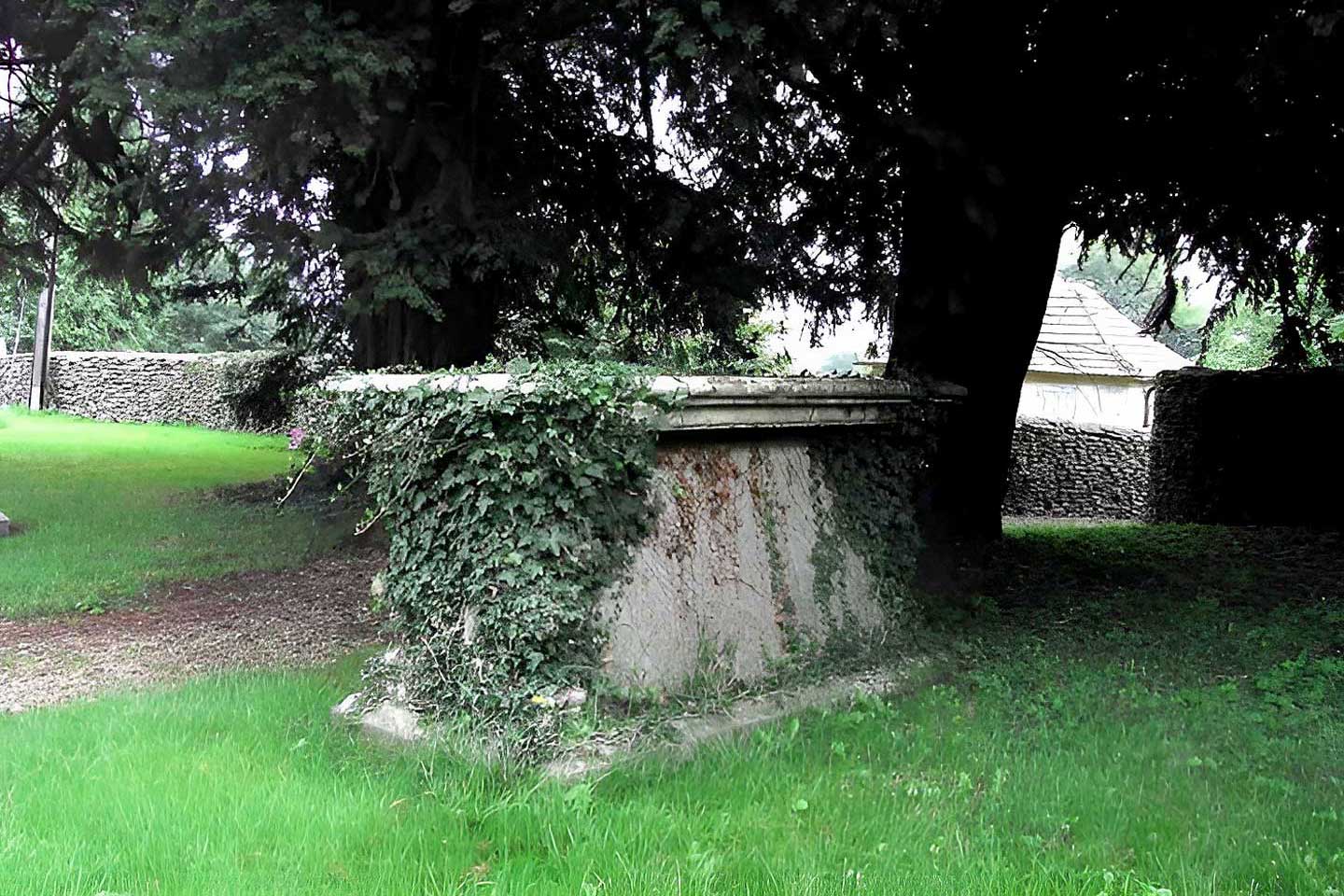
After
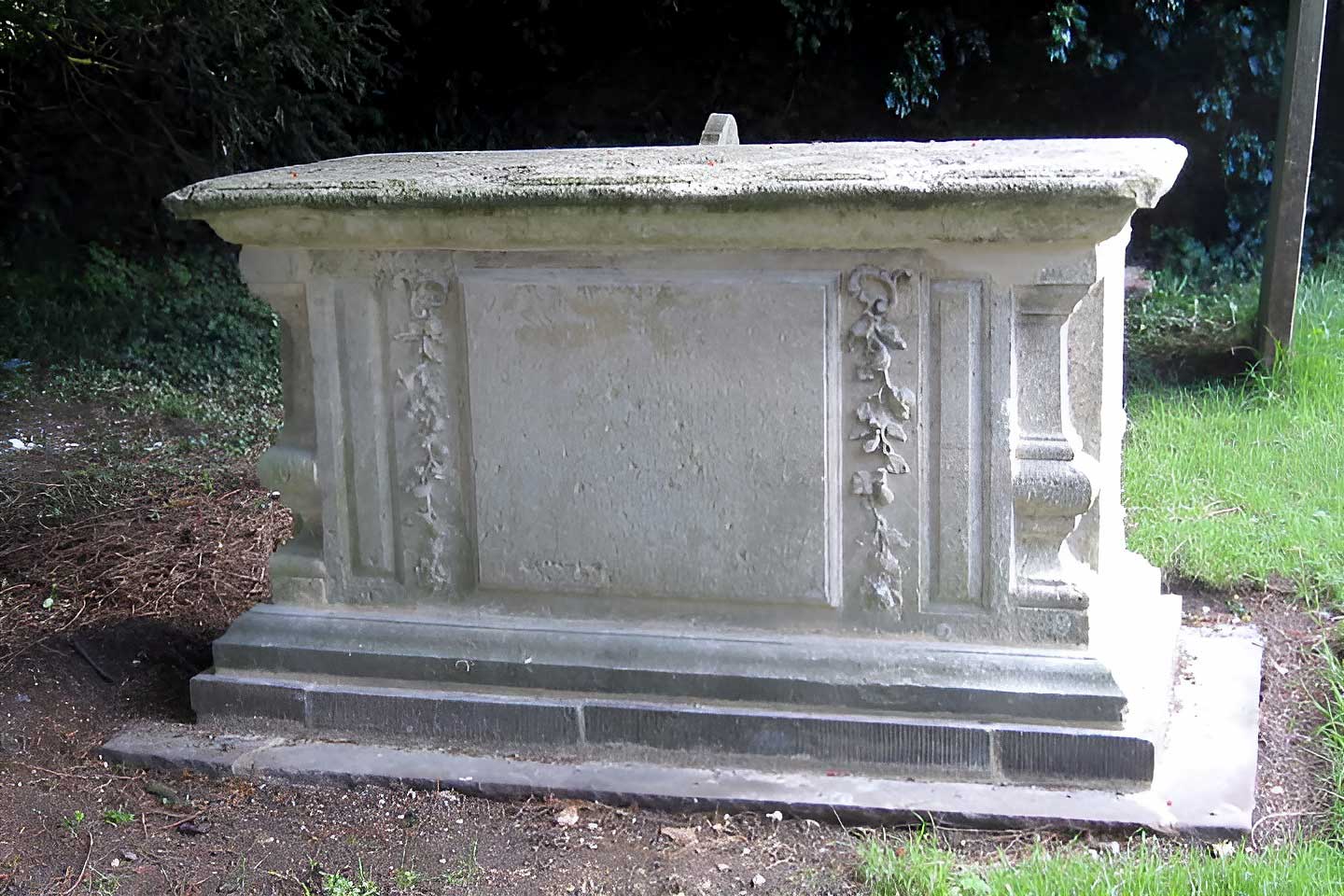
Conservation work
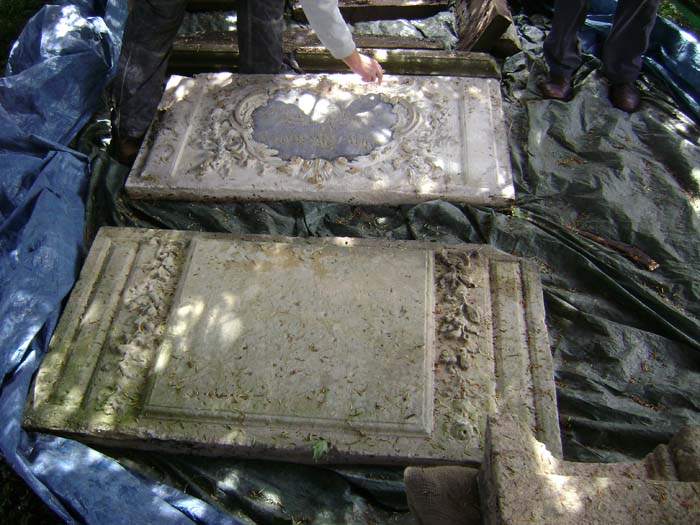
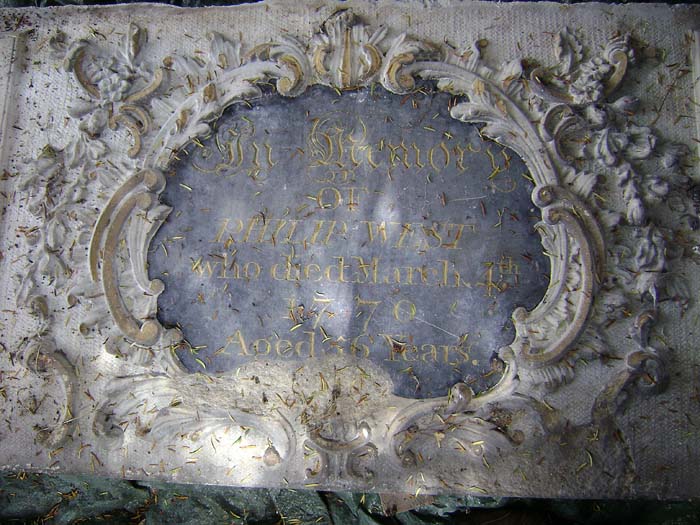
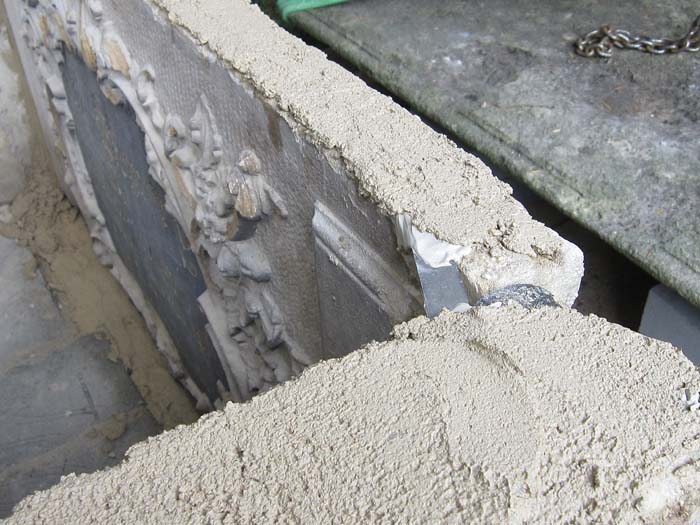
Firstly, the turf and the vegetation from the joints and stone faces were cleared and the stability assessed. The tomb was then strapped to hold the sides together whilst the top was lifted off. Once the lid was lifted the ivy was cleared from the inside of the tomb. This revealed that the south side panel had a carved cartouche and inscription on the inside face in an upside down position. Amazingly this still had its painted decoration mostly intact. The whole was painted with a white limewash with yellow ground and small traces of gold leaf on the raised tendrils of the foliate decoration. The background showed punched tooling marks that added to the decor. The central cartouche, was painted in a smooth black with gold/yellow lettering. The name, Philip West, was also on the outside north panel so it was assumed that this was originally part of the tomb. It had suffered slight damage on the lower decoration of the cartouche but its survival was otherwise remarkably good. Was it placed like this because of the damage or was there a more intriguing reason? The mystery remained.
The surfaces were cleaned with dry brushes then with a V & A mix (50% water; 50% white spirit; non ionic detergent). The areas of flaking paint were consolidated with a 12% Paraloid acrylic resin consolidant. Then, after recording and allowing a period of time for interested parties to examine it, it was reinstated into the monument as it was found (apart from being placed the correct way up). The panel was fixed using stainless steel cramps set in lime mortar rather than resin making it easier to dismantle at a later date if needed. The rest of the monument was taken down to ground level and the roots that were disrupting the foundations were cut. The ground was then made level and the foundation stones relaid on a bed of NHL 5 mortar. A block core was built to the top level of the sandstone plinth (rather than to the middle) allowing for better ventilation inside the tomb and a more suitable environment for the survival of the paint and decoration on the inscribed panel.
The tomb was then rebuilt using a hydraulic lime mortar for fix, repointing and repairs. The slight soiling was cleaned from the top of the north side with clean water and soft bristle brushes. The turf around the base was cut back and a geo-textile liner was placed around all four sides and covered with top soil to reduce future weed growth.
Tomb 6 - work in progress
Inner and outer inscriptions to Philip West.
Tomb 6 - work in progress
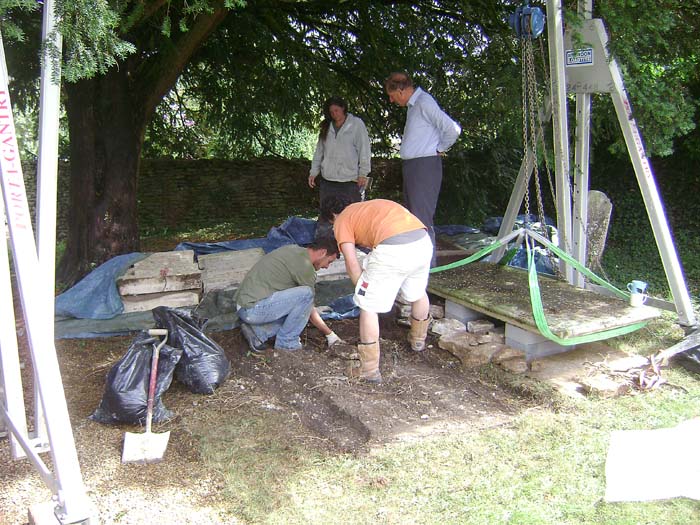
Inscription and carving on the inside of the south panel of the tomb.
Tomb 6 - work in progress
Earth base exposed after complete disassembly of the tomb.
Tomb 6 - work in progress
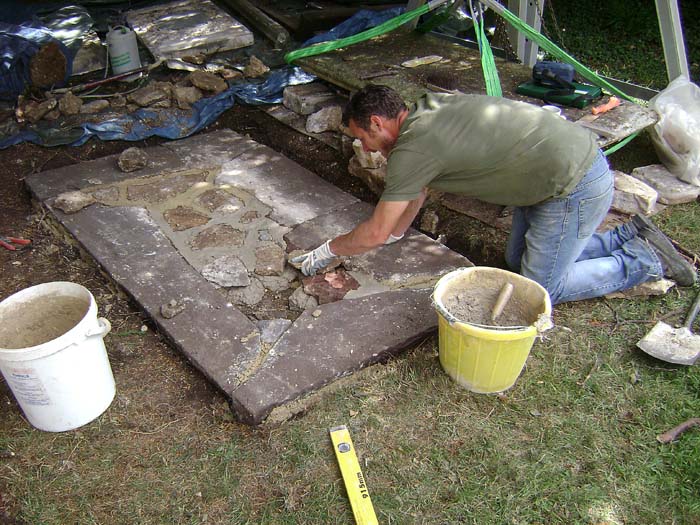
Preparing a new base from old pieces of tomb 6 using lime mortar.
Tomb 6 - work in progress
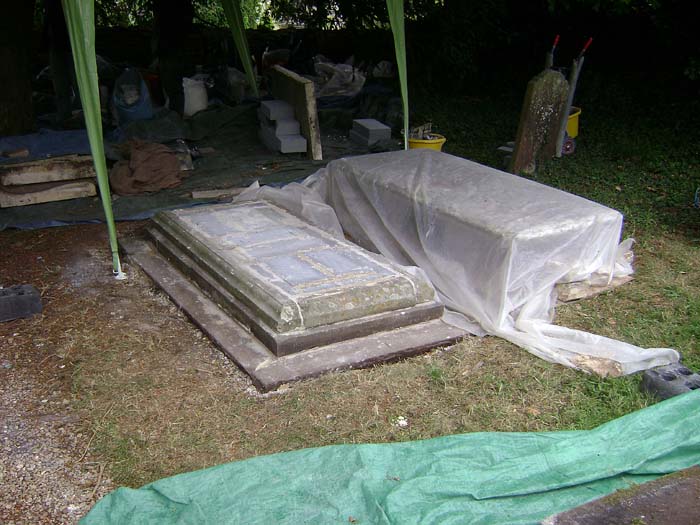
Base completed ready for reassembly of the tomb.
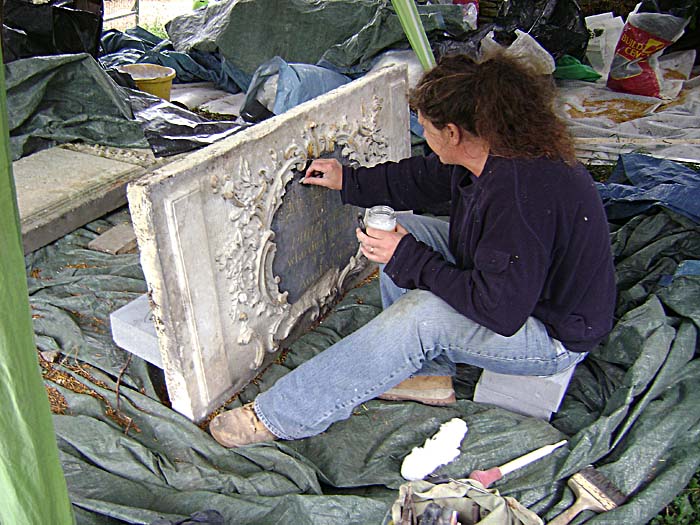
Tomb 6 - work in progress
Cleaning the amazing Philip West inscription and carvings.
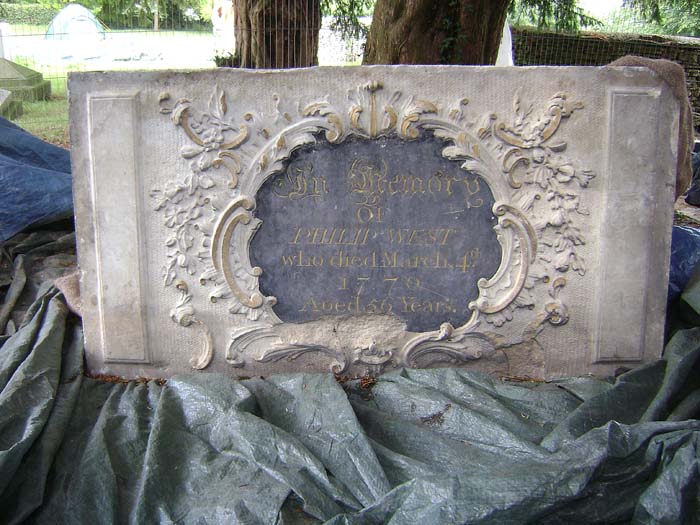
Tomb 6 - work in progress
Philip West inscription and carvings ready for reassembly.
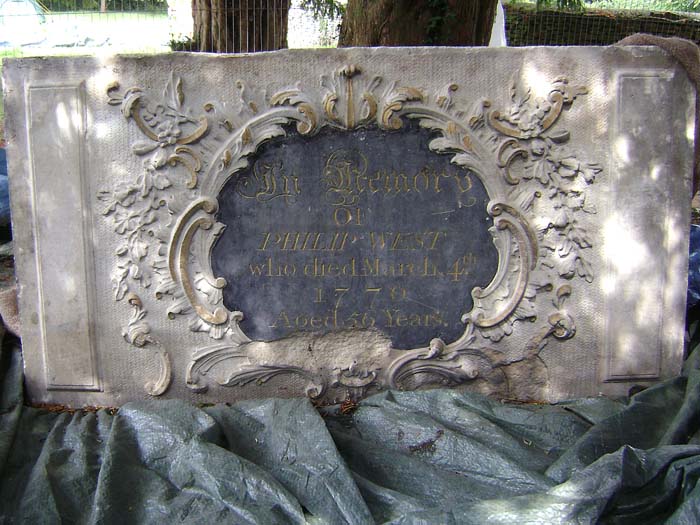
Tomb 6 - work in progress
Philip West inscription and carvings with reliefs emphasised by shadow.
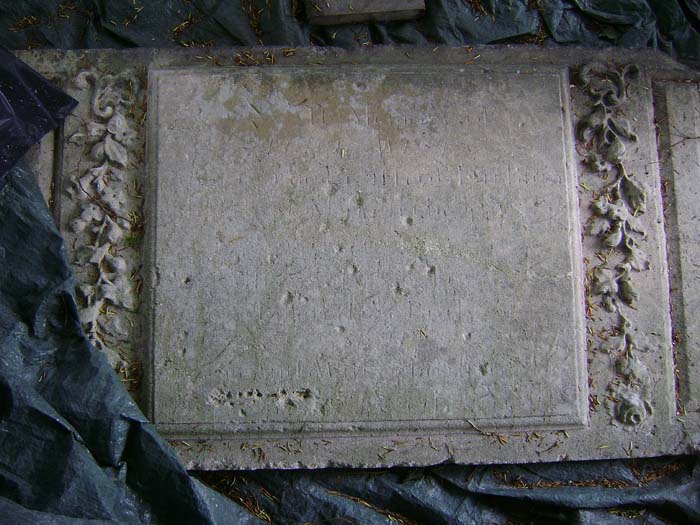
Tomb 6 - work in progress
North face inscriptions cleaned.
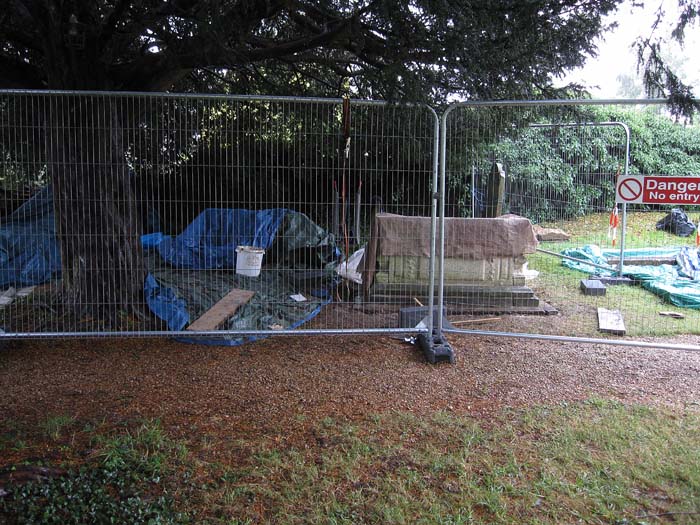
Tomb 6 - work in progress
Tomb partly assembled and 'drying' in the rain waiting for a decision on the orientation of the special Philip West inscription panel.
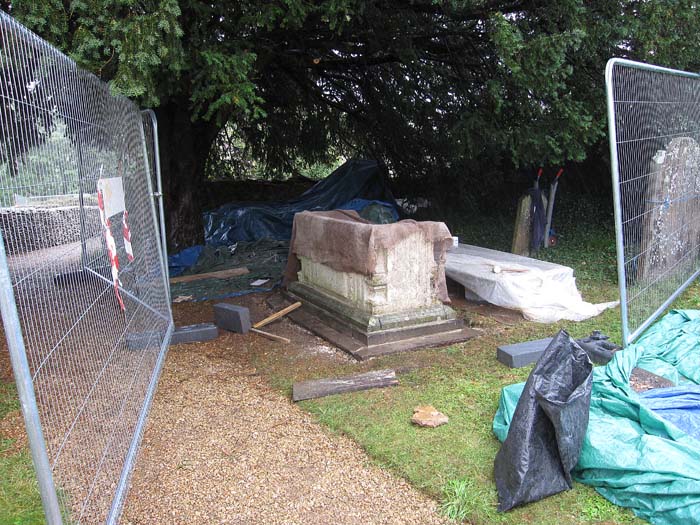
Tomb 6 - work in progress
Tomb partly assembled - note the 'new' foundation.
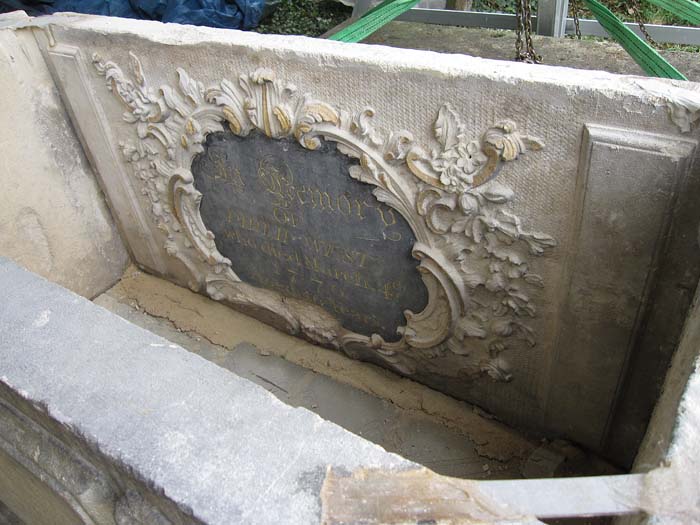
Tomb 6 - work in progress
Philip West panel installed the right way up but facing inwards as it was on disassembly.
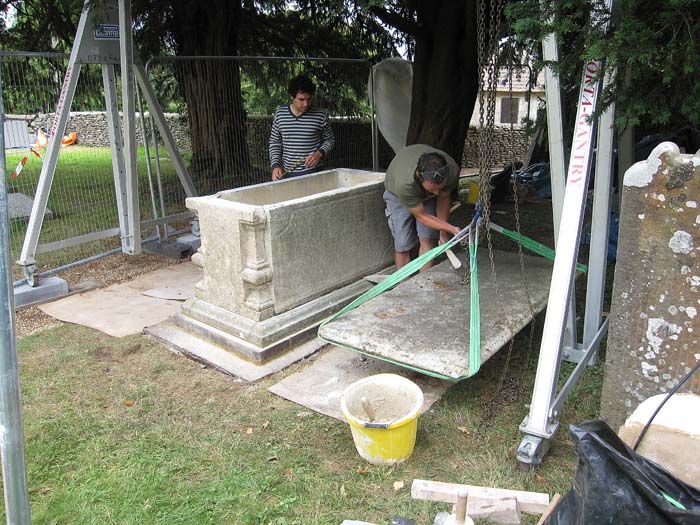
Tomb 6 - work in progress
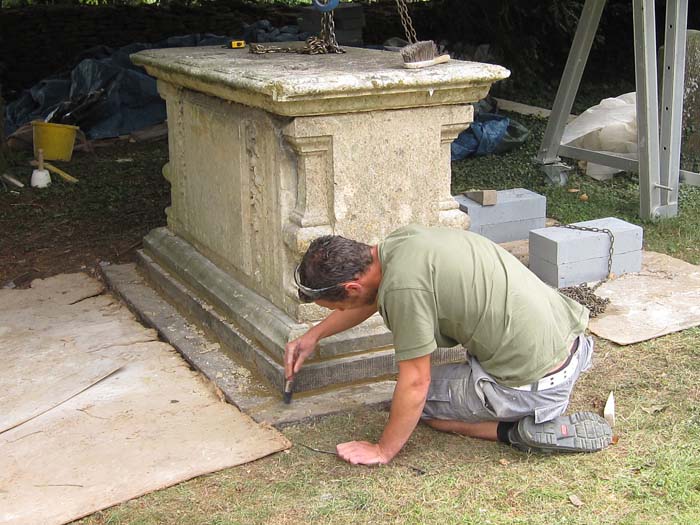
Preparing to install the top slab and complete assembly.
Tomb 6 - work in progress
Top corner cramps set in lime mortar to ease future access to the Philip West carved panel if needed.
Tomb 6 - work in progress
Assembly completed - cleaning up.
Tomb 6 - work in progress
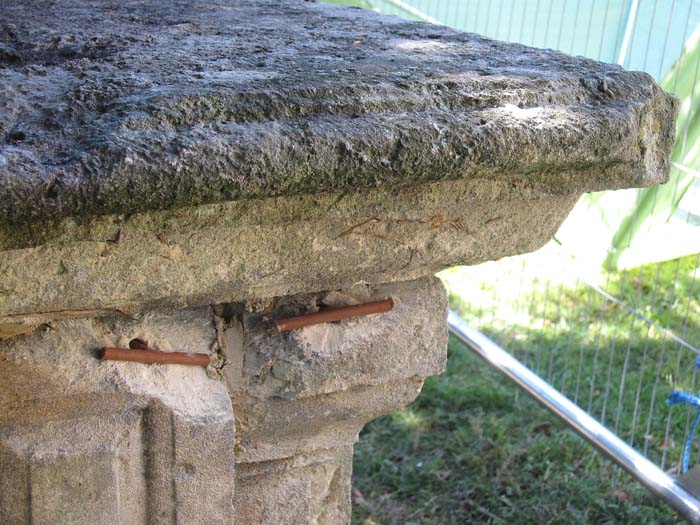
Clay reinforcing pins being used to strengthen filling for corner voids.
Tomb No.7 (Baldwin)
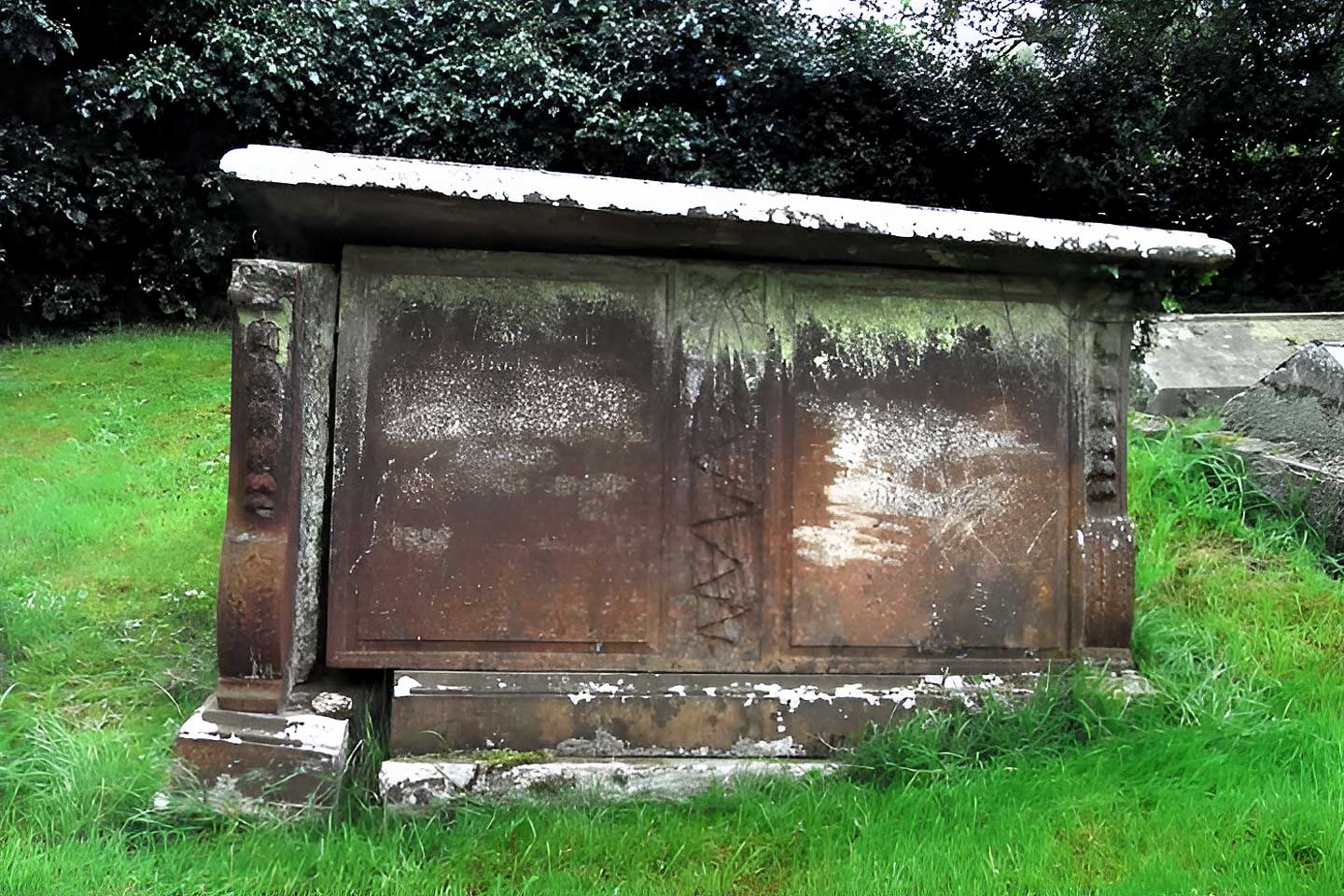
An 18th Century table top tomb in fine grained green sandstone (Listed Grade II Ref 6/305) with a monolithic lid with a simple moulding on the unde side and two lyre end stones decorated with flower margents on the edges and blank oval inscription panels. The north side panel is divided into two moulded framed inscription panel by a swag of drapery. The monument was in a precarious condition. Underground movement, overgrown ivy and failed rusting cramps had all contributed to the partial collapse of the tomb. It is covered in an interesting range of coloured lichens. There is a raised gravestone in close proximity on the north side.
Before
After
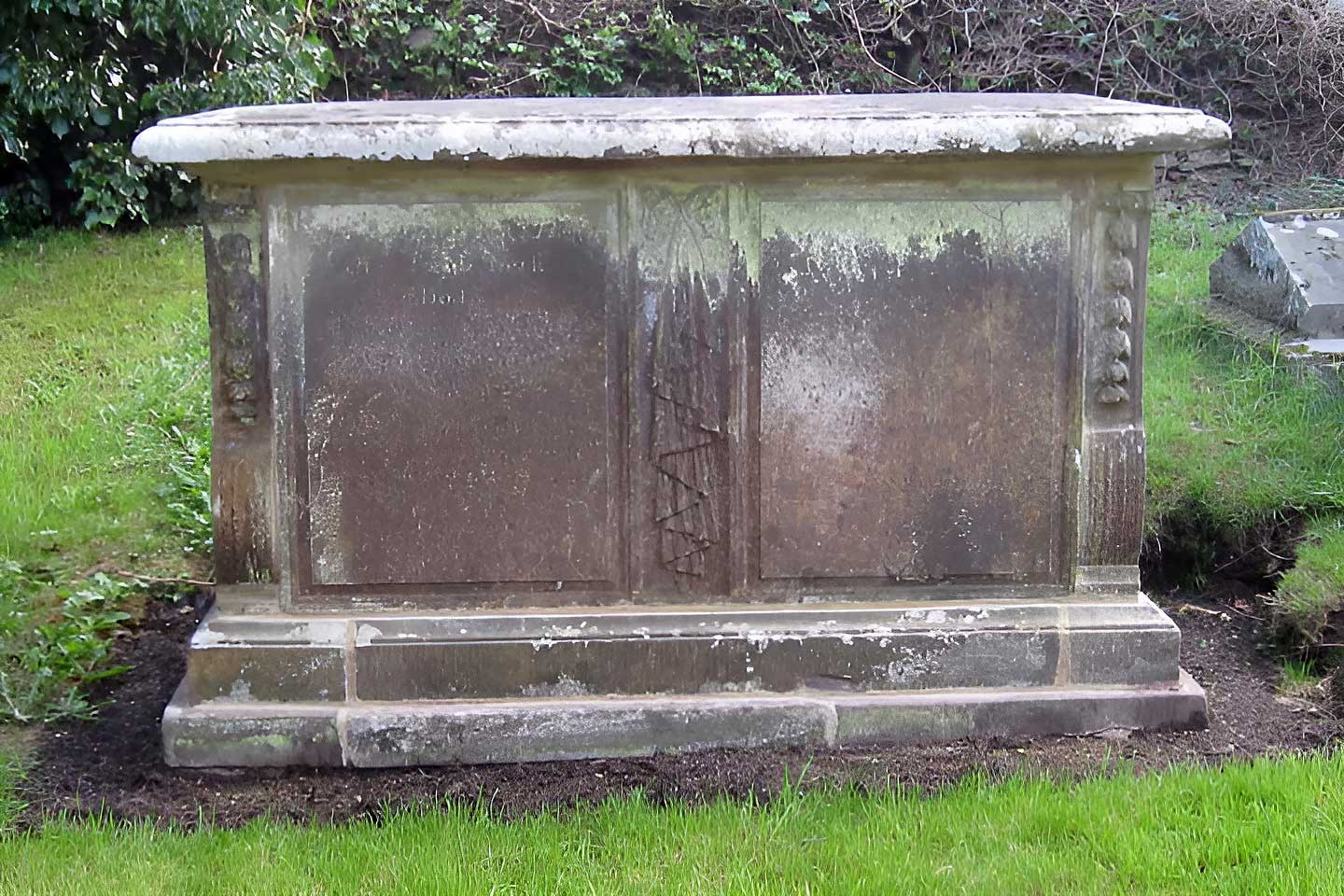
Conservation work
Firstly, the ivy was carefully cut away from the tomb and the turf cut away from the uplifted plinth stones where accessible. The vulnerable carving at the top of the south side panel was protected with holding mortar repairs before dismantling. The south side was propped and all sides were strapped together whilst the tomb lid was lifted. The sides were then dismantled one by one and all vegetation and iron was removed.
The four plinth stones had rested on a large sandstone foundation slab that had snapped into three pieces. These were lifted away once their position was marked, and the ground inspected to see what subsidence could be discovered. Fortunately, the grave below the tomb appeared intact indicating that the subsidence was under the adjacent grave. It was decided to replace the foundation stones just slightly further south so that they sat fully on the wall lined grave below. A lime concrete mortar was laid over the earth filled grave and the broken foundation stones laid on top and pointed up. The plinth stones were then set in position and the rest of the monument erected using stainless steel cramps for tying in the corners and a lime mortar for pointing and mortar repairs. Some grouting was also carried out using a hydraulic lime mix in small areas of delamination.
The turf around the base was cut back and a geo-textile liner was placed around all four sides and covered with top soil to reduce future weed growth.
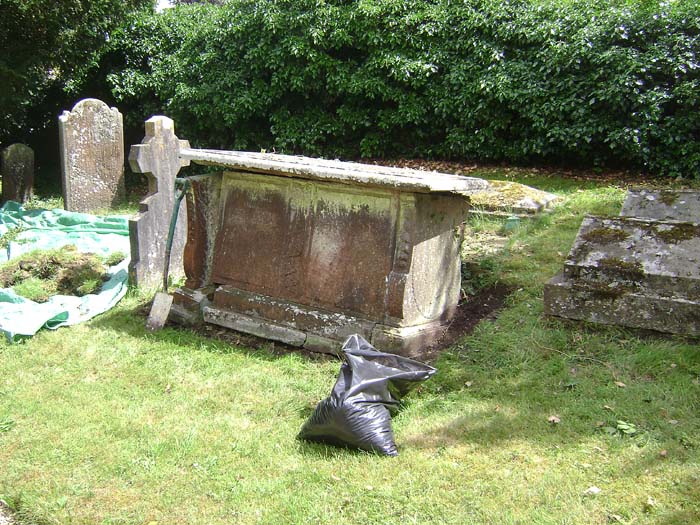
Tomb 7 - work in progress
Turf cleared away at the base of the tomb.
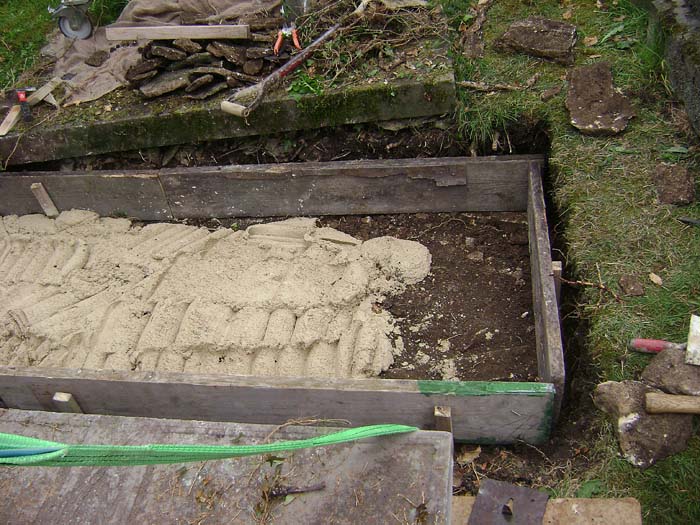
Tomb 7 - work in progress
Base being prepared - note outline of cenotaph below.
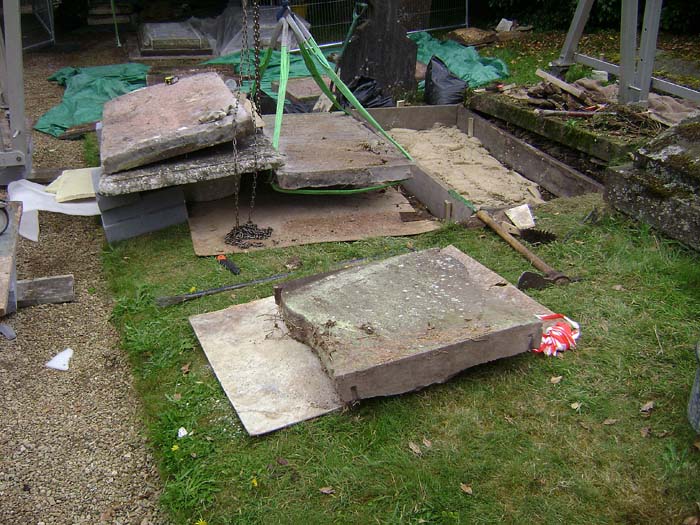
Tomb 7 - work in progress
Boarded base being filled with lime mortar.
Tomb 7 - work in progress
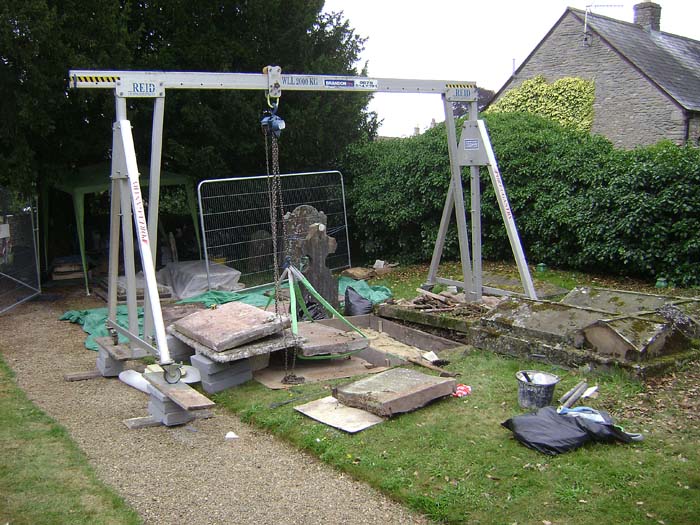
Awaiting assembly.
Tomb 7 - work in progress
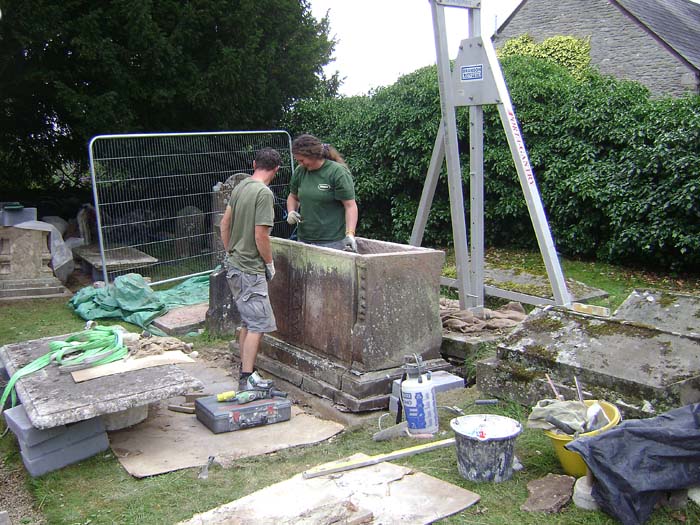
Progressing the reassembly.
Tomb 7 - work in progress
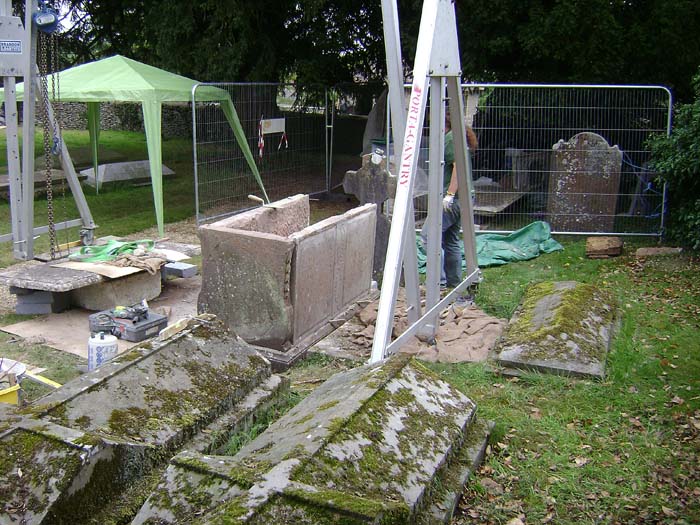
Progressing the reassembly.
Tomb 7 - work in progress
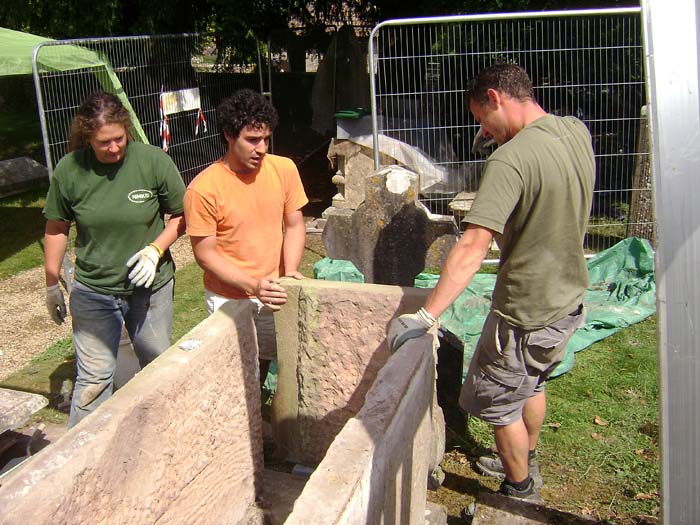
Fitting the end slabs.
Tomb 7 - work in progress
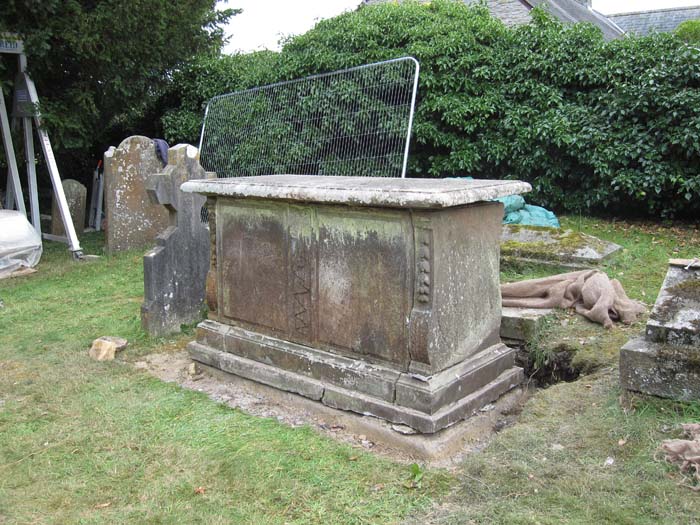
Assembly completed and awaiting final filling.
Tomb No.8 (Osborne)
An 18th Century table top tomb in fine grained green sandstone (Listed Grade II Ref 6/306) with a roll top moulded lid and four standing panels. The east and west ends are lyre ended with margent strips decorating the edges and inscriptions only on the east end. The north panel is divided elegantly into two oval inscription panels separated by what appears to by a phoenix rising from the flames and a pile of books below. Traces of white and black pigment can be found in this area. This monument was in remarkable condition with only a few open joints and plant growth. There is a Bath stone, ashlar lined coffin shaped grave, covered by rough hewn limestone slabs, to the north of the tomb.
Before
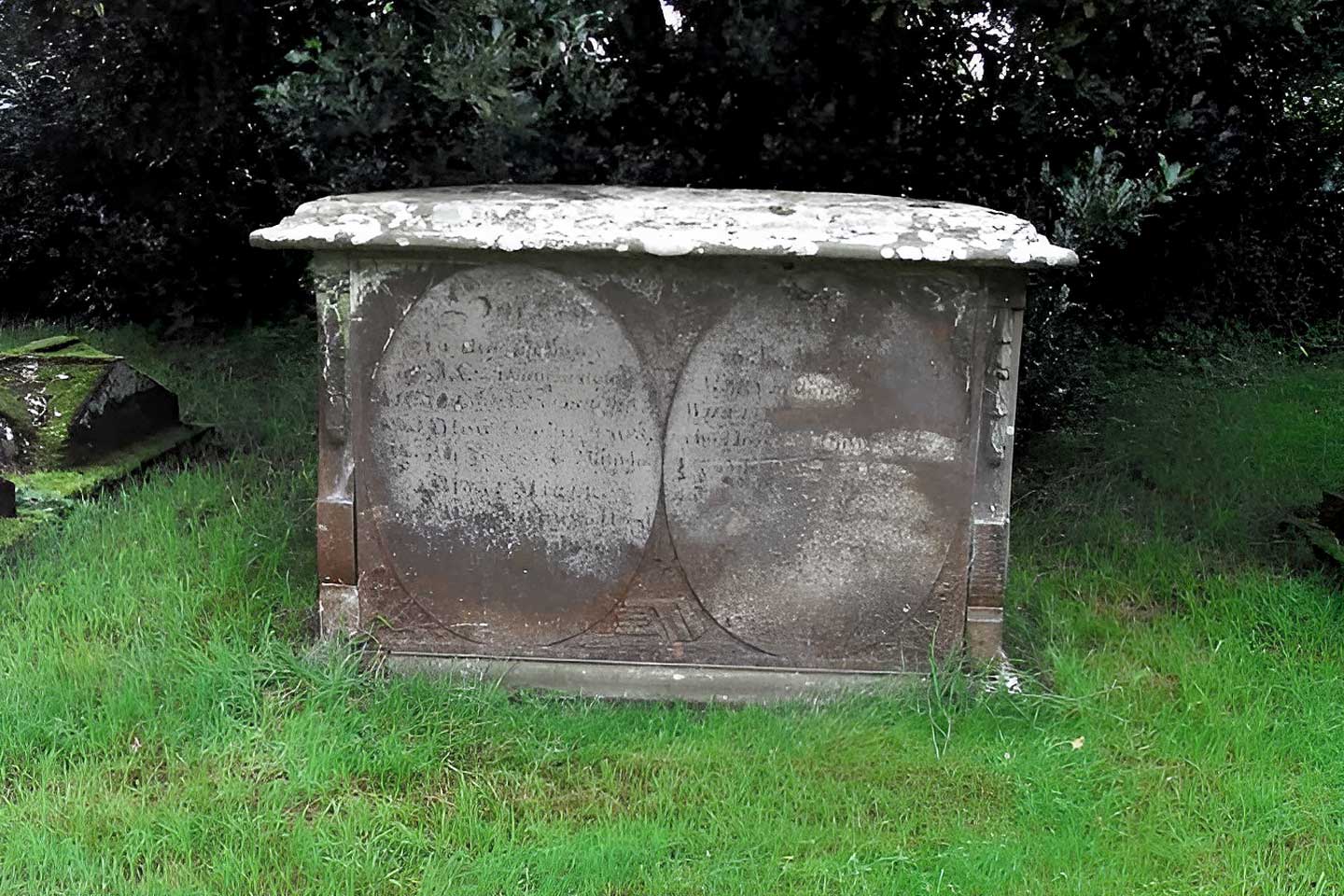
After
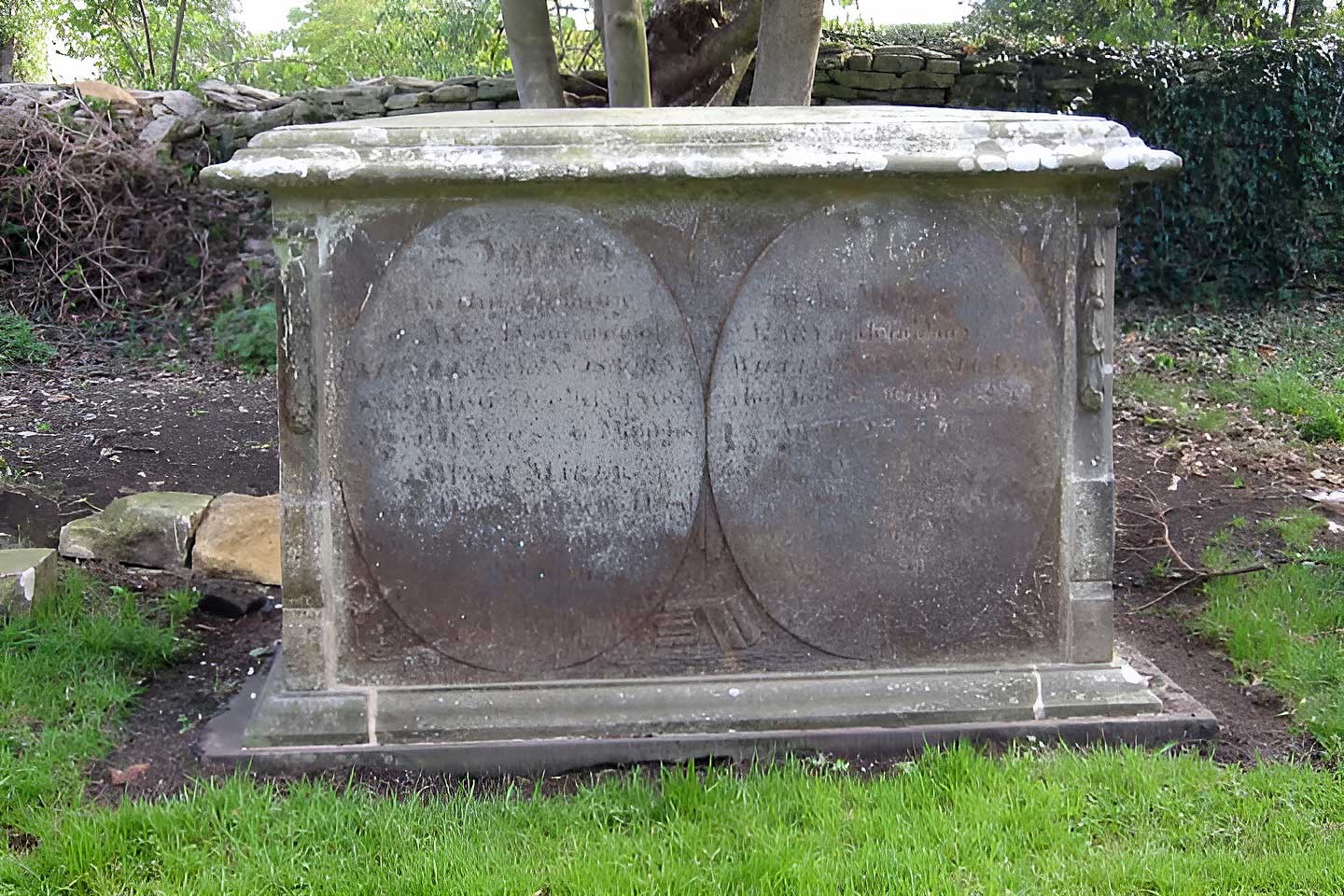
Conservation work
Firstly, the turf was cut away around the plinth of the monument and all vegetation and all joints were cleared. The joints were then pointed up by deep packing the mortar as far as possible, in some cases feeding in slate packers. The laminating sandstone on the north side was grouted and repaired using a hydraulic lime and Trass mix. A geo-textile liner was placed around all four sides of the tomb and covered with top soil to reduce future weed growth.
The grave to the north was further investigated with the expert assistance of Gwynne Stock from Tormarton. The grave was c560mm wide and 1900mm long, in-filled with soil and small pieces of rubble. The ashlar blocks were panels 90mm thick and very tightly bedded in neat lime putty. After the grave was investigated, it was in-filled with gravel and top soil and the stone slabs relaid over the top.
Tomb 8 - work in progress
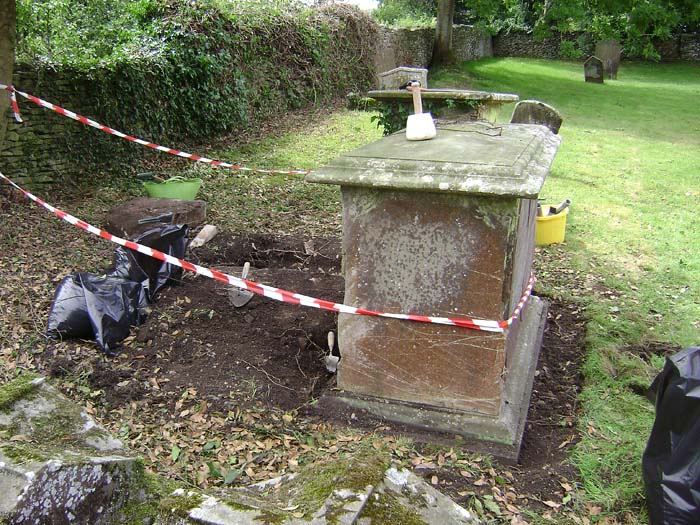
Turf lifted from adjacent void (grave?).
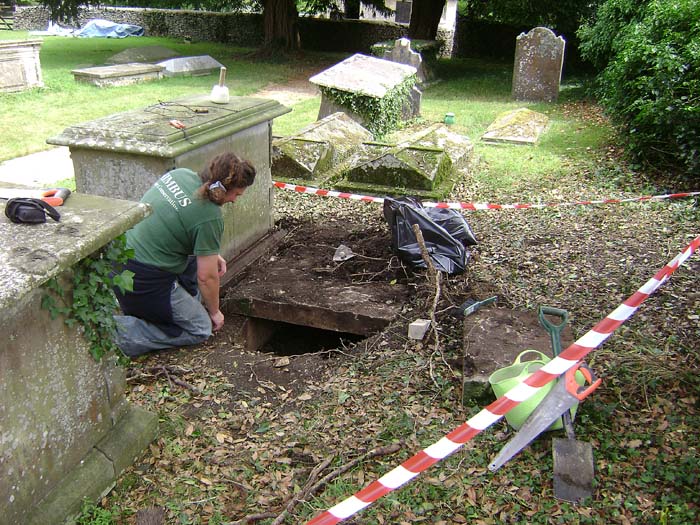
Tomb 8 - work in progress
Adjacent void top slab lifted.
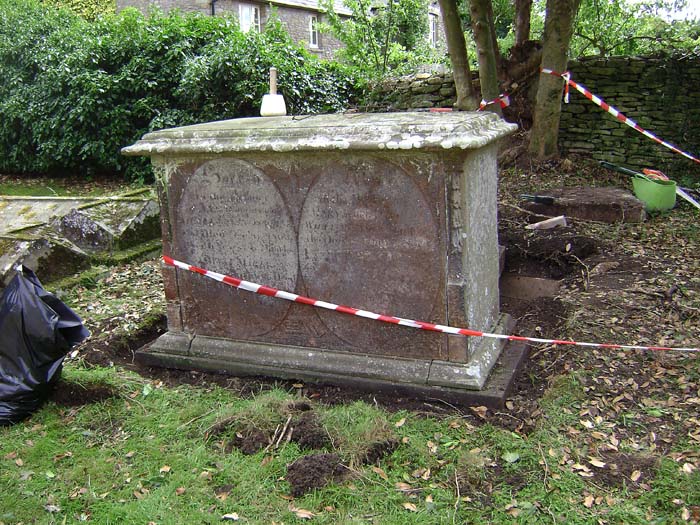
Tomb 8 - work in progress
Area cleard and prepared for work
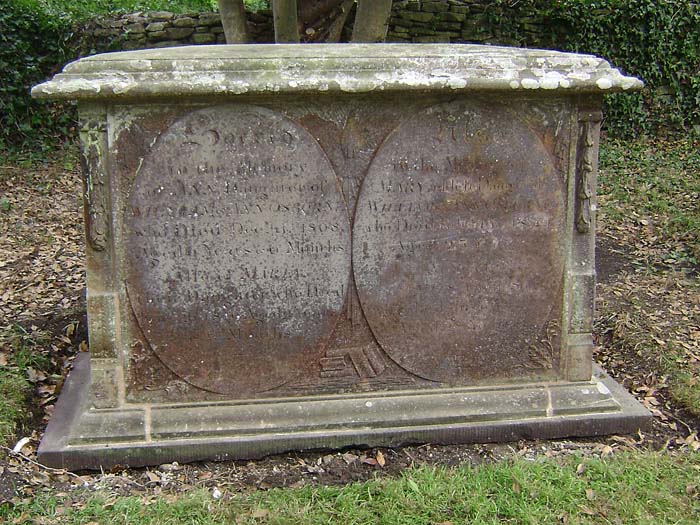
Tomb 8 - work in progress
Tomb base cleaned and filled.
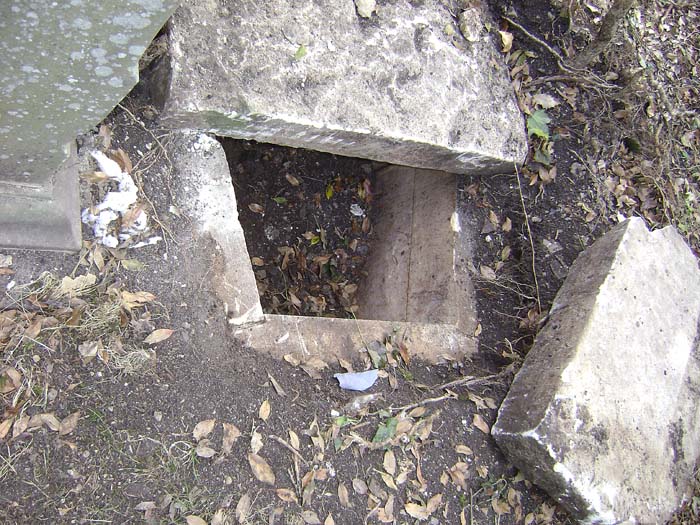
Tomb 8 - work in progress
Exposition of the chamber beside the tomb.
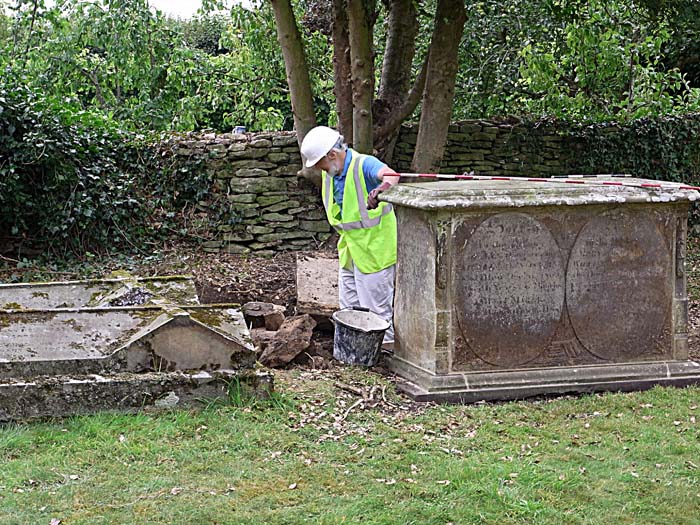
Tomb 8 - work in progress
Gwynne Stock investigates the walled chamber beside the tomb.
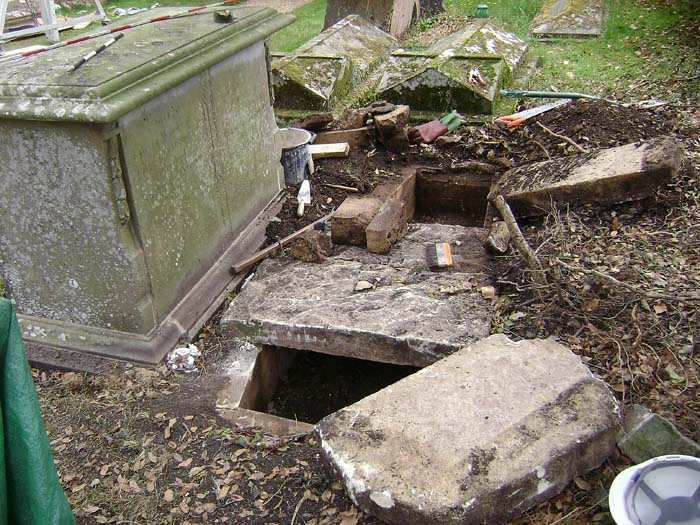
Tomb 8 - work in progress
Further exposition of the chamber beside the tomb.
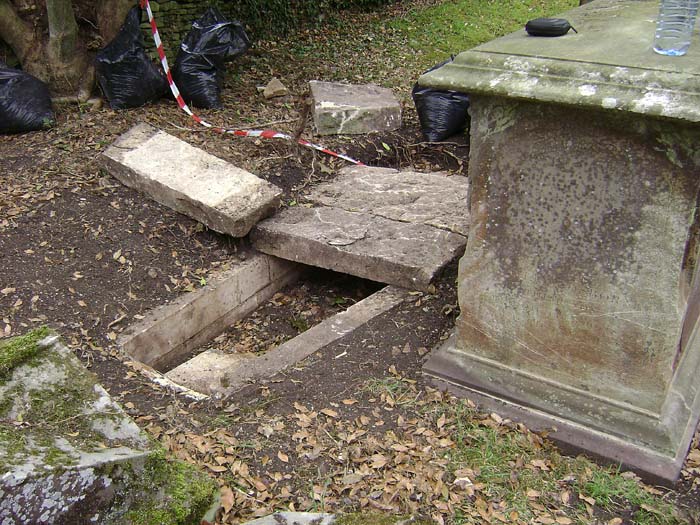
Tomb 8 - work in progress
Further view of the chamber beside the tomb.
Tomb No.9 (Osborne)
An 18th Century table top tomb in fine grained green sandstone (Listed Grade II Ref 6/307) with a monolithic lid with a simple moulding below. The two ends are lyre shaped with four drop margents on the sides. Inscriptions are legible on the north side panel. The four plinth stones have a simple moulding and the whole appears to sits on a large foundation stone. Although sound, vegetation including ivy had grown into the joints of the tomb and there was a slight crack and lacunae on the top right corner of the north facing west end panel indicating that some pressure was being exerted by rusting iron fixings. The south panel appeared to tip slightly in. The whole is covered in a variety of interesting lichens. There is a grave aligned to the north side of the tomb.
Before
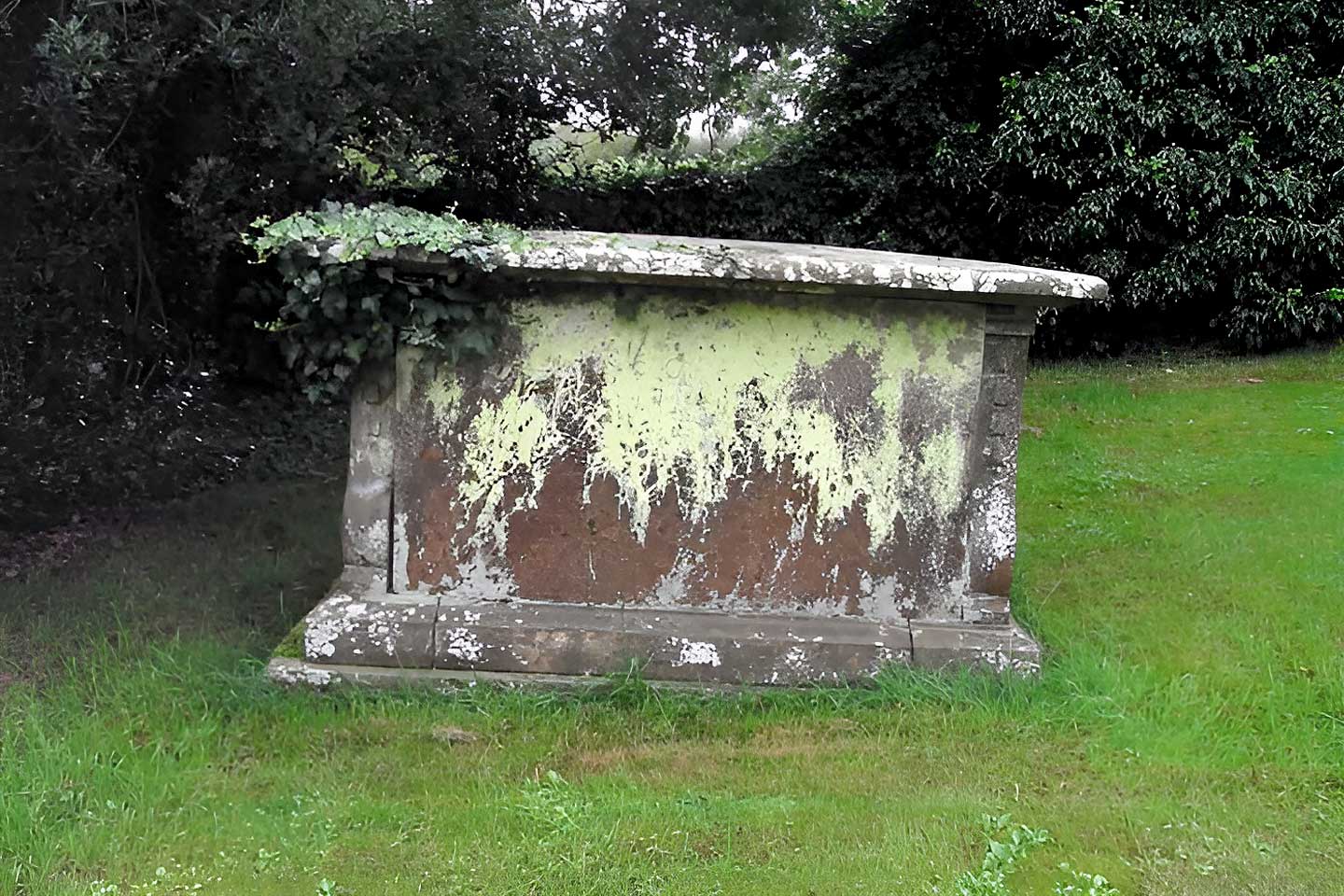
After
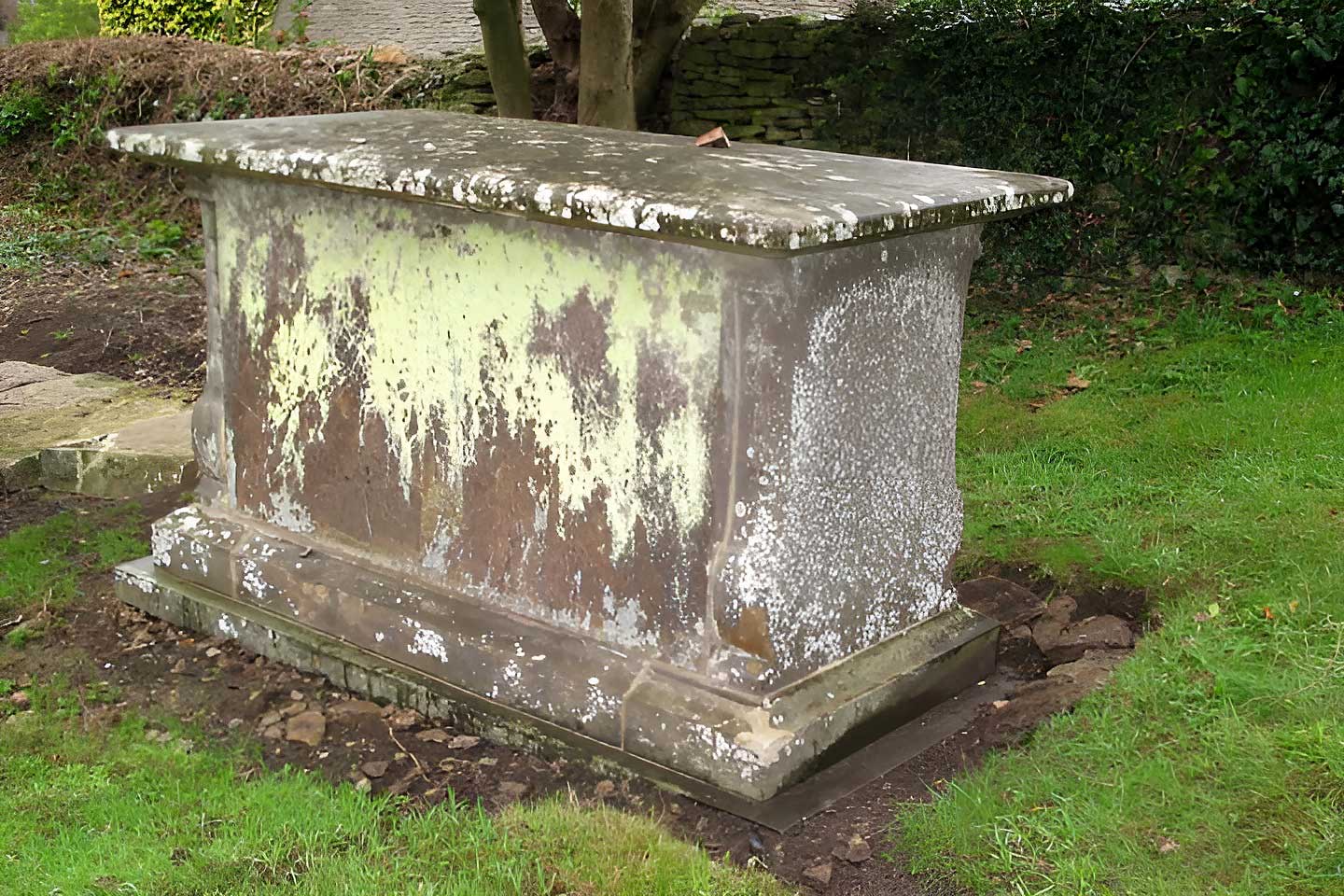
Conservation work
The lid was lifted to investigate the condition of the iron cramps and to allow access inside to clear any root systems. Once lifted the iron cramps were seen to be rusting substantially so they were replaced with stainless steel ones (grade 316). The south panel was realigned and the lid returned to position. The open joints were packed full with a hydraulic lime mortar and minimal mortar repairs were carried out.
The turf around the base was cut back and a geo-textile liner was placed around all four sides and covered with top soil to reduce future weed growth.
The grave to the north side of the tomb was excavated by Gwynne Stock. The turf was rolled back to uncover 4 roughly hewn Bath stone slabs which, when lifted, exposed a Bath stone ashlar lined coffin shaped grave 1.1m deep. This has a bath slab base, probably with a burial beneath.
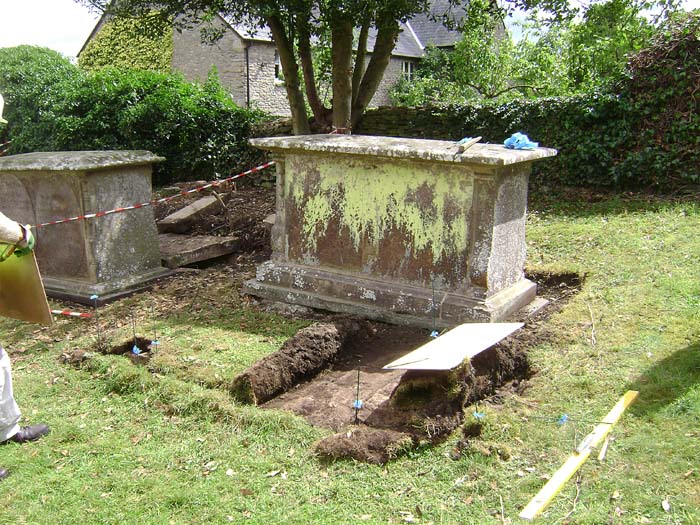
Tomb 9 - work in progress
Lifting turf from hidden slabs beside the tomb.
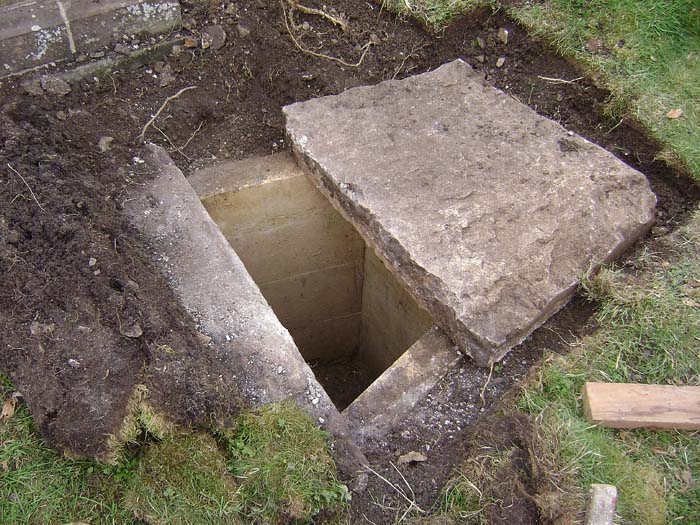
Tomb 9 - work in progress
Empty cenotaph beside the tomb.
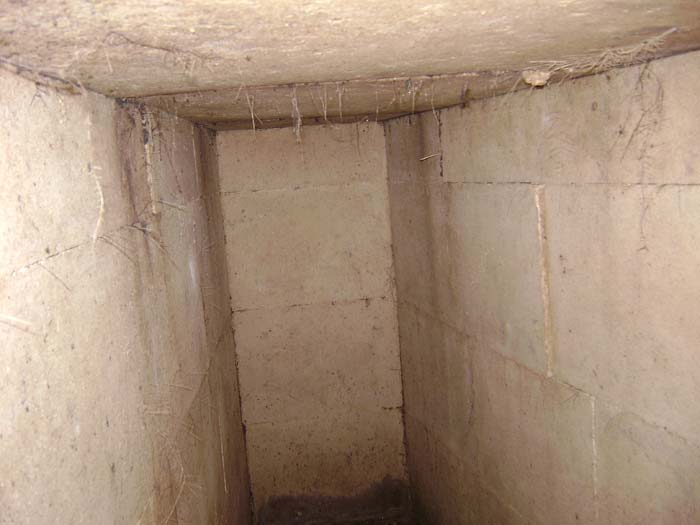
Tomb 9 - work in progress
Sides and roof of cenotaph - measured depth 43 inches.
Tomb 9 - work in progress
Lichen staining on the tomb.